Implied powers are a key concept in American politics, but what do they mean and where do they come from? In this article, we will explain the definition, origin and examples of implied powers, and how they relate to the Constitution and the federal government.
Contents
What are implied powers?
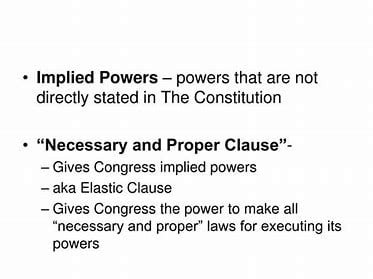
Implied powers are political powers that are not explicitly stated in the Constitution, but are inferred from other powers that are granted to the federal government. They are based on the idea that the government needs to have some flexibility and authority to deal with situations that the framers of the Constitution could not have anticipated.
According to Wikipedia, implied powers are “those that can reasonably be assumed to flow from express powers, though not explicitly mentioned.” For example, the Constitution gives Congress the power to regulate commerce among the states, but it does not mention the power to create a national bank. However, this power can be implied from the commerce clause, as a national bank would facilitate trade and commerce.
Where do implied powers come from?
The concept of implied powers has been debated since the founding of the United States. One of the earliest controversies was over the constitutionality of the First Bank of the United States, which was proposed by Alexander Hamilton in 1791 to manage the national debt and currency. Hamilton argued that although the Constitution did not explicitly authorize Congress to create a bank, it gave Congress implied powers to do so under the necessary and proper clause, which states that Congress can “make all laws which shall be necessary and proper for carrying into execution” its enumerated powers.
However, some opponents of the bank, such as Thomas Jefferson and James Madison, argued that Congress could only exercise powers that were expressly granted by the Constitution, and that creating a bank was not necessary or proper for executing its powers. They feared that allowing Congress to use implied powers would lead to an expansion of federal authority at the expense of state rights.
The debate over implied powers was settled by the Supreme Court in 1819, in the case of McCulloch v. Maryland. The case involved a dispute over whether Maryland could tax the Second Bank of the United States, which was chartered by Congress in 1816. The Court, led by Chief Justice John Marshall, ruled in favor of the federal government and upheld the constitutionality of the bank. Marshall agreed with Hamilton’s argument that Congress had implied powers under the necessary and proper clause, and that creating a bank was a legitimate means to execute its express powers. He also affirmed that federal laws were supreme over state laws, and that states could not interfere with or tax federal institutions.
What are some examples of implied powers?
Since McCulloch v. Maryland, Congress has used its implied powers to enact various laws and policies that are not explicitly mentioned in the Constitution. Some examples of implied powers are:
– The power to draft soldiers into the military, based on the power to declare war and raise armies.
– The power to establish a national minimum wage, based on the power to regulate interstate commerce.
– The power to create federal agencies such as NASA or EPA, based on the power to provide for the general welfare.
– The power to prohibit racial discrimination in public places, based on the power to enforce civil rights amendments.
– The power to regulate immigration and naturalization, based on the power to establish a uniform rule of naturalization.
Conclusion
Implied powers are political powers that are not explicitly stated in the Constitution, but are inferred from other powers that are granted to the federal government. They are based on the idea that the government needs to have some flexibility and authority to deal with situations that the framers of the Constitution could not have anticipated. The concept of implied powers has been debated since the founding of the United States, but was affirmed by the Supreme Court in 1819 in McCulloch v. Maryland. Since then, Congress has used its implied powers to enact various laws and policies that affect various aspects of American life.
