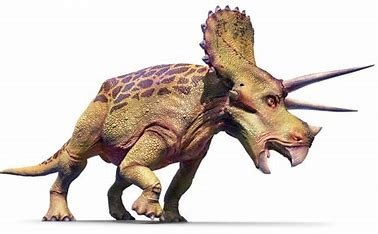
Triceratops is one of the most iconic and recognizable dinosaurs, with its three horns and massive frill. But have you ever wondered what living animal is most closely related to this ancient beast? The answer may surprise you.
Triceratops: A Brief Overview
Triceratops, which means “three-horned face” in Greek, was a herbivorous dinosaur that lived in the late Cretaceous period, about 68 to 66 million years ago, in what is now western North America. It was one of the last non-avian dinosaurs to exist before the mass extinction event that wiped out most of them.
Triceratops was a huge animal, comparable in size to an African elephant. It grew up to 30 feet (9 meters) long and weighed over 11,000 lbs (5,000 kg). Some large specimens weighed nearly 15,750 lbs (7,150 kg). It had strong limbs to support its massive body and move around.
Triceratops had a distinctive skull, which could reach over 7 feet (2 meters) in length. It had three horns on its head: two long ones above its eyes and a shorter one on its snout. The horns were made of bone covered by keratin, the same material as human fingernails and hair. The horns were probably used for defense against predators, such as Tyrannosaurus rex, or for display and competition among members of the same species.
Triceratops also had a large frill of bone at the back of its skull, which was bordered by numerous small spikes. The frill may have served as a shield to protect the neck and shoulders, or as a display structure to attract mates or intimidate rivals. The frill may have also helped regulate body temperature by acting as a radiator.
Triceratops had a bird-like beak and hundreds of teeth arranged in columns. These teeth were specialized for shearing and grinding tough plant matter, such as cycads, ginkgoes, and conifers. Triceratops could clip off hundreds of pounds of vegetation every day with its powerful jaws.
What Animal is Related to Triceratops?
To answer this question, we need to look at the evolutionary history of Triceratops and its relatives. Triceratops belonged to a group of dinosaurs called ceratopsians, which means “horned faces”. Ceratopsians were a diverse and successful group of herbivorous dinosaurs that flourished in the late Cretaceous period.
Ceratopsians are classified into two subgroups: centrosaurines and chasmosaurines. Centrosaurines had short frills and large nasal horns, while chasmosaurines had long frills and small nasal horns. Triceratops was a chasmosaurine, along with other famous dinosaurs such as Torosaurus and Pentaceratops.
Ceratopsians are part of a larger group of dinosaurs called ornithischians, which means “bird-hipped”. Ornithischians were one of the two major groups of dinosaurs, along with saurischians, which means “lizard-hipped”. Ornithischians included other herbivorous dinosaurs such as stegosaurs, ankylosaurs, pachycephalosaurs, and hadrosaurs.
Ornithischians are distinguished by having a pelvis that resembles that of modern birds, although they are not closely related to them. Birds are actually descended from saurischian dinosaurs, specifically theropods, which were mostly carnivorous dinosaurs such as Tyrannosaurus rex and Velociraptor.
So what living animal is most closely related to Triceratops? The answer is… none. Triceratops has no living relatives that share a common ancestor with it more recently than about 250 million years ago. That is when the first dinosaurs diverged from their reptilian ancestors.
The closest living relatives of Triceratops are crocodilians and birds, which are both members of the group Archosauria, along with dinosaurs. However, these groups split from each other very early in the evolution of archosaurs, so they are only distantly related.
Some people may think that rhinos or elephants are related to Triceratops because they have similar body shapes and horns or tusks. However, these animals are mammals, not reptiles or birds. They belong to a completely different branch of the evolutionary tree than Triceratops.
Rhinos and elephants evolved their horns or tusks independently from Triceratops through a process called convergent evolution. This is when unrelated organisms evolve similar features because they live in similar environments or face similar challenges. For example, bats and birds both have wings, but they are not closely related. They evolved wings separately because they both needed to fly.
Conclusion
Triceratops was a magnificent and unique dinosaur that had no living relatives. It was part of a diverse and successful group of herbivorous dinosaurs that dominated the late Cretaceous period. It had a distinctive skull with three horns and a large frill that were probably used for defense, display, and temperature regulation. It had a bird-like beak and hundreds of teeth that were adapted for eating tough plants.
Triceratops was not related to any living animal, except for very distantly to crocodilians and birds. It was not related to rhinos or elephants, which evolved their horns or tusks independently through convergent evolution. Triceratops was a one-of-a-kind creature that we can only admire through its fossils and reconstructions.
