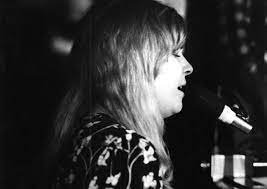
Sandy Denny was one of the most captivating voices of her era, a singer-songwriter who fronted the British folk rock band Fairport Convention and collaborated with Led Zeppelin. She had a talent that was praised by critics and fans alike, but also a troubled life that ended too soon. What was the cause of death of Sandy Denny, and how did it affect her legacy?
A Promising Start
Sandy Denny was born on January 6, 1947, in London, England. She showed an interest in singing and music from an early age, and studied classical piano as a child. She also had a passion for folk music, especially the traditional songs of her Scottish heritage. She began performing in folk clubs in the mid-1960s, and soon gained a reputation for her powerful and expressive voice.
In 1968, she joined Fairport Convention, a band that was experimenting with blending folk and rock music. She brought along her knowledge of folk songs and her distinctive vocal style, and became the lead singer of the group. She also contributed as a songwriter, composing some of the band’s most memorable songs, such as “Who Knows Where the Time Goes?” and “Fotheringay”.
With Denny, Fairport Convention achieved critical acclaim and commercial success, especially with their landmark album Liege & Lief, which is considered one of the founding works of British folk rock. Denny also sang a duet with Robert Plant on “The Battle of Evermore” for Led Zeppelin’s fourth album, which exposed her to a wider audience and cemented her status as a folk rock icon.
A Downward Spiral
However, Denny’s career was not without difficulties and challenges. She left Fairport Convention in 1969, after a tragic car accident that killed two of her bandmates. She formed a new band, Fotheringay, but it disbanded after one album. She then embarked on a solo career, releasing four albums between 1971 and 1977. Although her solo work was well-received by critics, it did not sell as well as her previous albums with Fairport Convention.
Denny also struggled with personal issues, such as depression, alcoholism, and self-harm. She had a turbulent relationship with her husband, Trevor Lucas, who was also a musician and her producer. They had a daughter, Georgia, in 1977, but their marriage was strained by Denny’s substance abuse and erratic behavior. Lucas left Denny in early 1978, taking their daughter with him.
Denny’s health deteriorated as a result of her addiction and neglect. She suffered from several falls, which caused head injuries and brain damage. She was also diagnosed with a rare form of anemia, which made her prone to bleeding and bruising.
A Tragic End
On April 17, 1978, Denny collapsed and fell into a coma while staying at a friend’s home. She was rushed to the hospital, where she died four days later, at the age of 31. The cause of death was a traumatic mid-brain hemorrhage, caused by blunt force trauma to her head. According to some sources, the fatal injury was the result of a fall down a flight of stairs, while others suggest it was a complication of her previous falls and medical condition.
Denny’s death shocked and saddened the music world, and left a void in the folk rock scene. Her fans and peers mourned her loss, and paid tribute to her talent and legacy. Her songs have been covered by many artists, such as Judy Collins, Nina Simone, and Cat Power. Her recordings have been reissued and remastered, and her unreleased material has been made available to the public. She has been inducted into the BBC Radio 2 Folk Awards Hall of Fame, and ranked among the greatest singers of all time by Rolling Stone and other publications.
Sandy Denny cause of death was a tragic outcome of a life that was full of promise, but also of pain and struggle. She was a folk rock legend, who left behind a rich and influential body of work, and a voice that still resonates today.
