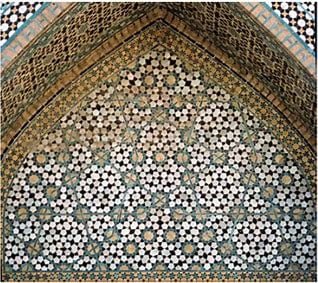
Islamic architecture is one of the most distinctive and influential styles of building design in the world. It reflects the cultural, religious, and artistic values of the Islamic civilization that spanned from the 7th century to the present day. Islamic architecture encompasses a variety of structures, such as mosques, madrasas, tombs, palaces, fountains, and gardens, that serve both secular and religious functions. However, one of the most striking features of Islamic architecture is its use of geometry as a means of expression, decoration, and symbolism.
Contents
The Role of Geometry in Islamic Architecture
Geometry is a branch of mathematics that deals with shapes, patterns, angles, and proportions. It is also a universal language that transcends cultural and linguistic barriers. For Muslims, geometry is not only a tool for measuring and constructing buildings, but also a way of reflecting the divine order and beauty of creation. According to Islamic belief, God is the source of all knowledge and wisdom, and He reveals Himself through His signs (ayat) in nature and in the Quran. Geometry is one of the ways that Muslims can appreciate and emulate God’s signs, as well as express their faith and devotion.
Geometry plays a vital role in Islamic architecture in several ways. First, it helps to create harmonious and balanced proportions that reflect the unity and harmony of God’s creation. For example, many Islamic buildings use the golden ratio, a mathematical proportion that produces aesthetically pleasing shapes and forms. The golden ratio can be found in nature, such as in the spiral of a shell or the arrangement of petals in a flower. It can also be seen in the design of some famous Islamic buildings, such as the Taj Mahal in India or the Alhambra in Spain.
Second, geometry helps to create intricate and diverse patterns that adorn the surfaces of Islamic buildings. These patterns are known as arabesques, which are composed of geometric shapes such as circles, squares, triangles, hexagons, octagons, and stars. Arabesques can be combined and repeated to form complex and symmetrical designs that cover walls, ceilings, floors, domes, arches, windows, doors, and minarets. Arabesques are not only decorative but also symbolic. They represent the infinite nature of God and His creation, as well as the diversity and unity of the Islamic community.
Third, geometry helps to create calligraphic art that inscribes verses from the Quran or other religious texts on Islamic buildings. Calligraphy is the art of writing beautifully and elegantly using Arabic script. It is considered one of the highest forms of art in Islam because it conveys the word of God and His attributes. Calligraphy can be seen as a form of geometry because it uses lines, curves, dots, and angles to create letters and words. Calligraphy can be integrated with arabesques or other geometric motifs to create stunning visual effects that enhance the meaning and beauty of the text.
Examples of Geometric Art in Islamic Architecture
There are many examples of geometric art in Islamic architecture across different regions and periods. Here are some notable ones:
- The Dome of the Rock in Jerusalem is one of the earliest and most iconic examples of Islamic architecture. It was built in 691 CE by the Umayyad caliph Abd al-Malik on the site where Muslims believe Prophet Muhammad ascended to heaven. The dome is covered with gold tiles and surrounded by an octagonal arcade with 16 windows. The exterior walls are decorated with mosaics that feature geometric patterns such as stars, polygons, interlocking circles, and floral motifs. The interior walls are also adorned with mosaics that include calligraphic inscriptions from the Quran.
- The Great Mosque of Cordoba in Spain is one of the most impressive examples of Islamic architecture in Europe. It was built between 784 and 987 CE by the Umayyad rulers of al-Andalus (Muslim Spain). The mosque has a rectangular plan with a large courtyard and a prayer hall with 19 naves and 12 transepts. The prayer hall is famous for its forest of columns that support double-tiered arches with alternating red and white stripes. The arches create a geometric pattern that resembles a honeycomb or a palm tree. The mihrab (prayer niche) is decorated with gold mosaics that form intricate geometric designs.
- The Selimiye Mosque in Edirne (Turkey) is one of the masterpieces of Ottoman architecture. It was built between 1568 and 1574 CE by Sultan Selim II and designed by the renowned architect Sinan. The mosque has a square plan with four minarets at each corner. The main dome is 31 meters in diameter and 43 meters high. It rests on eight massive pillars that are connected by four semi-domes. The interior walls are covered with tiles that feature geometric patterns such as stars, hexagons, and octagons. The dome is also decorated with calligraphic inscriptions from the Quran.
- The Shah Mosque in Isfahan (Iran) is one of the finest examples of Safavid architecture. It was built between 1611 and 1638 CE by Shah Abbas I as part of the royal complex of Naqsh-e Jahan Square. The mosque has a rectangular plan with four iwans (vaulted halls) that face a central courtyard. The main iwan is flanked by two minarets and leads to the prayer hall with a huge dome. The exterior walls are covered with tiles that feature geometric patterns such as stars, polygons, and interlocking circles. The interior walls are also adorned with tiles that include calligraphic inscriptions from the Quran.
- The Jama Masjid in Delhi (India) is one of the largest and most magnificent examples of Mughal architecture. It was built between 1644 and 1656 CE by Emperor Shah Jahan, who also built the Taj Mahal. The mosque has a rectangular plan with three domes and two minarets. The domes are crowned with lotus-shaped finials and have black and white stripes. The minarets have white marble shafts and red sandstone balconies. The exterior walls are decorated with red sandstone and white marble that form geometric patterns such as chevrons, zigzags, and diamonds. The interior walls are also embellished with marble that includes calligraphic inscriptions from the Quran.
Conclusion
Islamic architecture is closely related to geometry because geometry is a way of expressing the Islamic worldview and values. Geometry helps to create harmonious and balanced proportions, intricate and diverse patterns, and calligraphic art that reflect the divine order and beauty of creation, the infinite nature of God and His creation, and the word of God and His attributes. Geometry also helps to create a visual language that transcends cultural and linguistic differences and unites the Islamic community across time and space. Islamic architecture is therefore a testimony to the richness and diversity of Islamic culture and civilization.
