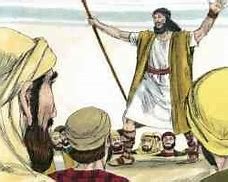
One of the most intriguing questions in the New Testament is whether John the Baptist and Jesus Christ were related. The Gospels portray John as the forerunner of Jesus, the one who prepared the way for the Messiah by preaching repentance and baptizing people in the Jordan River. But were they also cousins, as some traditions suggest? And what was the nature and purpose of their relationship?
The Biblical Evidence
The Gospel of Luke gives us the most information about the possible kinship between John and Jesus. In Luke 1, we read that both of their births were announced by the angel Gabriel to their respective parents. John’s father was Zechariah, a priest of the tribe of Levi, and his mother was Elizabeth, who was also a descendant of Aaron (Luke 1:5). Jesus’ father was Joseph, a descendant of David, and his mother was Mary, who was betrothed to Joseph (Luke 1:26-27).
The angel Gabriel told Mary that she would conceive a son by the power of the Holy Spirit, and that he would be called the Son of God (Luke 1:31-35). He also told her that her relative Elizabeth was pregnant with a son in her old age, and that he would be filled with the Holy Spirit even from his mother’s womb (Luke 1:36-37). Mary then visited Elizabeth, and when Elizabeth heard Mary’s greeting, her baby leaped in her womb, and she was filled with the Holy Spirit. She exclaimed:
“Blessed are you among women, and blessed is the child you will bear! But why am I so favored, that the mother of my Lord should come to me? As soon as the sound of your greeting reached my ears, the baby in my womb leaped for joy. Blessed is she who has believed that the Lord would fulfill his promises to her!” (Luke 1:42-45)
This passage implies that Mary and Elizabeth were relatives, but it does not specify how closely they were related. The Greek word used for “relative” is συγγενής (syngenēs), which can mean anything from a near or far relative, such as a cousin, an aunt, a niece, etc. (according to Biblical Hermeneutics Stack Exchange). Therefore, we cannot be certain about the exact degree of kinship between John and Jesus based on this word alone.
However, some scholars have suggested that Mary and Elizabeth were cousins on their mothers’ side, based on a tradition recorded by Eusebius, an early church historian. He wrote that Mary’s mother was named Anna, and that she had a sister named Ismeria, who was married to a man named Eleazar. They had a daughter named Elizabeth, who married Zechariah and gave birth to John (according to Eusebius’ History of the Church). If this tradition is true, then John and Jesus were second cousins.
The Prophetic Role
Regardless of their biological relationship, John and Jesus had a special prophetic role in God’s plan of salvation. Both of them were foretold by the Old Testament prophets as part of God’s promise to send a Savior to his people. John was identified as the fulfillment of Isaiah’s prophecy about “a voice of one calling in the wilderness: ‘Prepare the way for the Lord; make straight paths for him’” (Isaiah 40:3; cf. Matthew 3:3; Mark 1:3; Luke 3:4; John 1:23). He was also compared to Elijah, who was expected to return before the great and dreadful day of the Lord (Malachi 4:5-6; cf. Matthew 11:14; 17:10-13; Mark 9:11-13; Luke 1:17).
Jesus was identified as the fulfillment of many prophecies about the Messiah, such as Isaiah’s prophecy about “a child born to us, a son given to us” who would be called “Wonderful Counselor, Mighty God, Everlasting Father, Prince of Peace” (Isaiah 9:6; cf. Matthew 1:21-23; Luke 2:10-14). He was also recognized as the Son of David, the Son of Abraham, and the Son of God (Matthew 1:1; 22:41-46; Luke 3:23-38; John 1:34).
John’s mission was to prepare people for Jesus’ coming by preaching repentance and baptizing them with water. He said:
“I baptize you with water for repentance. But after me comes one who is more powerful than I, whose sandals I am not worthy to carry. He will baptize you with the Holy Spirit and fire. His winnowing fork is in his hand, and he will clear his threshing floor, gathering his wheat into the barn and burning up the chaff with unquenchable fire.” (Matthew 3:11-12)
John also pointed people to Jesus as the Lamb of God who takes away the sin of the world (John 1:29-36). He acknowledged that Jesus was greater than him, and that he must decrease while Jesus must increase (John 3:27-30).
Jesus’ mission was to reveal God’s love and grace to the world by teaching, healing, and performing miracles. He said:
“The Spirit of the Lord is on me, because he has anointed me to proclaim good news to the poor. He has sent me to proclaim freedom for the prisoners and recovery of sight for the blind, to set the oppressed free, to proclaim the year of the Lord’s favor.” (Luke 4:18-19)
Jesus also fulfilled God’s law and righteousness by living a sinless life and dying on the cross as a sacrifice for our sins. He said:
“Do not think that I have come to abolish the Law or the Prophets; I have not come to abolish them but to fulfill them.” (Matthew 5:17)
“For even the Son of Man did not come to be served, but to serve, and to give his life as a ransom for many.” (Mark 10:45)
Jesus also rose from the dead on the third day, defeating death and sin, and ascended to heaven, where he sits at the right hand of God. He said:
“I am the resurrection and the life. The one who believes in me will live, even though they die; and whoever lives by believing in me will never die.” (John 11:25-26)
“All authority in heaven and on earth has been given to me. Therefore go and make disciples of all nations, baptizing them in the name of the Father and of the Son and of the Holy Spirit, and teaching them to obey everything I have commanded you. And surely I am with you always, to the very end of the age.” (Matthew 28:18-20)
The Humble Attitude
Both John and Jesus had a humble attitude toward their relationship. They did not boast or compete with each other, but rather respected and honored each other. John showed his humility by saying that he was not worthy to untie Jesus’ sandals, let alone baptize him (Matthew 3:13-15; Mark 1:7-9; Luke 3:15-16; John 1:26-27). He also rejoiced when he saw Jesus’ ministry growing, saying that he was glad to hear his voice as a bridegroom’s friend (John 3:29-30).
Jesus showed his humility by submitting to John’s baptism, even though he had no need of repentance (Matthew 3:13-17; Mark 1:9-11; Luke 3:21-22). He also praised John as a great prophet, saying that among those born of women there was no one greater than him (Matthew 11:7-15; Luke 7:24-28). He also defended John’s honor when he was criticized by some Pharisees and lawyers, saying that they rejected God’s purpose for themselves by not accepting John’s baptism (Luke 7:29-30).
The relationship between John and Jesus was a remarkable example of how God works through human history to accomplish his salvation plan. They were both chosen by God before their birth, filled with the Holy Spirit from their mother’s womb, and called to fulfill specific prophecies about the Messiah and his forerunner. They were also related by blood, but more importantly by faith. They recognized each other as brothers in God’s family, and loved each other as such. They were both humble servants of God, who did not seek their own glory, but God’s glory. They were both faithful witnesses of God’s truth, who did not fear human opposition, but God’s judgment. They were both martyrs for God’s cause, who did not cling to their earthly life, but God’s eternal life.
We can learn a lot from their relationship about how we should relate to Jesus as our Lord and Savior. We should follow John’s example of repentance and baptism, acknowledging our need for forgiveness and cleansing from our sins. We should follow Jesus’ example of obedience and sacrifice, giving our lives to him as a living offering of love and gratitude. We should also follow their example of humility and respect, honoring Jesus as our King and Master, and serving him with joy and faithfulness.
Is John the Baptist related to Jesus? The answer is yes, in more ways than one. But more importantly, are we related to Jesus? The answer is yes, if we believe in him as our Lord
