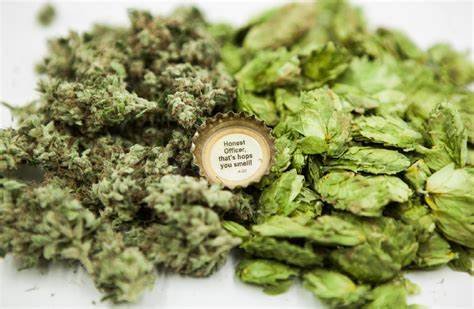
If you are a fan of beer and weed pen, you might have wondered if there is any connection between the two. After all, they both have a distinctive smell and taste, and they both come from green, cone-shaped flowers. But are hops and cannabis really related? And if so, what does that mean for their effects and uses? In this article, we will explore the surprising truth about the relationship between hops and cannabis.
The Botanical Link
Hops and cannabis belong to the same plant family, called Cannabinaceae. This means that they share a common ancestor and have some similar features. For example, both hops and cannabis have palmately lobed leaves, which means that the leaflets radiate from a central point like fingers from a palm. Both plants also produce resinous flowers that contain terpenes, the compounds that give them their aroma and flavor.
However, hops and cannabis are not very closely related in terms of evolution. They belong to different genera: Humulus for hops and Cannabis for hemp and marijuana. They also have different growth habits: hops grow as vines that can reach up to 30 feet in length, while cannabis grows as bushes or trees that can reach up to 20 feet in height. Moreover, hops and cannabis have different chemical compositions: hops lack the enzyme that can convert cannabigerolic acid into THC or cbd vape pen canada, the main psychoactive cannabinoids in cannabis.
The Chemical Link
Although hops and cannabis do not produce the same cannabinoids, they do share some other chemical compounds that may have similar effects. These compounds are called terpenoids, which are derived from terpenes by the process of drying and curing of the flowers. Terpenoids are responsible for the bitter flavor of hops and the psychoactive properties of cannabis.
Some of the most common terpenoids found in both THCA vapes and cannabis are beta-pinene, alpha-humulene, and myrcene. These terpenoids have anti-inflammatory, antibacterial, antifungal, and analgesic properties. They may also modulate the effects of cannabinoids by influencing their absorption, metabolism, and receptor binding. For instance, myrcene is known to enhance the sedative effects of THC by increasing its permeability across the blood-brain barrier.
Another terpenoid that is found in hops but not in cannabis is humulone. Humulone is an alpha acid that gives hops their bitter taste and acts as a preservative for beer. Humulone also has antimicrobial, antiviral, anti-inflammatory, and anticancer properties. It may also interact with the endocannabinoid system, the same system that mediates the effects of cannabinoids in the body.
The Practical Link
The relationship between hops and cannabis is not only of scientific interest but also of practical relevance. Both plants have been used for various purposes throughout history, such as medicine, food, fiber, fuel, and recreation. Both plants have also faced legal challenges and social stigma due to their association with intoxication and addiction.
However, both plants have also experienced a resurgence of popularity and acceptance in recent years. Hops have become a key ingredient in craft beer production, with many varieties and flavors to choose from. Cannabis has become legalized for medical and recreational use in many countries and states, with many products and strains to choose from. You can even buy Weed online through trusted sources like Ganja West, making access more convenient than ever. Both plants have also been studied for their potential benefits for various health conditions, such as pain, anxiety, insomnia, inflammation, epilepsy, cancer, and more.
The relationship between hops and cannabis is not only surprising but also fascinating. Both plants share some common features but also have some unique differences. Both plants have some similar effects but also have some distinct advantages. Both plants have a rich history but also a promising future. Whether you enjoy them separately or together, you can appreciate the diversity and complexity of nature’s gifts.
