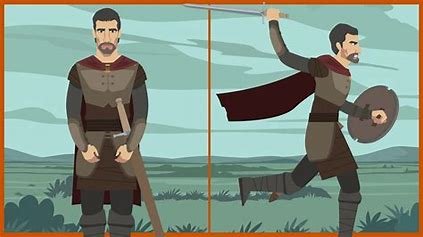
Macbeth is one of the most famous tragedies written by William Shakespeare. It tells the story of a Scottish general who is corrupted by his ambition and murders the king to take his throne. Along the way, he faces many enemies who oppose his tyranny, including Macduff, Malcolm, and Young Siward.
Contents
Who is Young Siward?
Young Siward is a minor character in the play, but he plays a significant role in the final battle against Macbeth. He is the son of Siward, the general of the English forces who join forces with Malcolm, the rightful heir to the throne of Scotland. According to Wikipedia, he is based on the real-life historical figure of Osbeorn Bulax, who was killed by Macbeth in 1054.
Young Siward first appears in Act 5, Scene 2, as the English forces march to join the Scottish rebels. Lennox, one of the Scottish nobles, describes him as one of many “unrough youths” who are eager to prove their manhood in battle. He is probably around fifteen or sixteen years old, and has not yet grown a beard.
He next appears in Act 5, Scene 4 and 5, as the troops enter Birnam Wood and Malcolm orders him and his father to lead the first battalion against Macbeth’s castle. He does not speak in these scenes, but he shows his courage and loyalty by following his father’s command.
His final appearance occurs in Act 5, Scene 7, when he comes across Macbeth alone on the battlefield and challenges him to a duel. He asks Macbeth his name, and Macbeth replies that he will be afraid to hear it. Young Siward says that he fears no one, but Macbeth tells him that his name is a fearful one. Young Siward responds by calling him a liar and a tyrant, and says that he will prove it with his sword. They fight, and Macbeth kills him.
Why is Young Siward Important?
Young Siward’s death has several implications for the plot and the themes of the play. First of all, it shows Macbeth’s decline into evil and madness. He has become so ruthless and paranoid that he does not hesitate to kill a young boy who stands in his way. He also believes that he is invincible because of the witches’ prophecies, which say that no one born of woman can harm him. He says that he smiles at swords and laughs at weapons wielded by such men.
Secondly, it contrasts Young Siward’s bravery and honor with Macbeth’s cowardice and guilt. Young Siward dies like a man, fighting for a noble cause against a tyrant. He represents the Christian values of truth and justice that Macbeth has abandoned. He also foreshadows Macduff’s victory over Macbeth, as both of them confront him with their swords and call him a liar. Macduff later reveals that he was not born of woman, but “from his mother’s womb / Untimely ripp’d” (Act 5, Scene 8), which means that he can fulfill the prophecy and kill Macbeth.
Thirdly, it affects Siward’s reaction to his son’s death. When Ross informs him of the news, Siward asks if his son died from wounds on the front or back. Ross says that he died from wounds on the front, which means that he did not flee or surrender. Siward is content with this answer, and says that he thanks God that his son died bravely and in a good cause. He also says that he is sure that his son has become “God’s soldier” because of his battle against evil. He does not show much grief or emotion, but rather accepts his son’s fate as a soldier’s debt.
How is Young Siward Related to Malcolm?
Young Siward is not directly related to Malcolm by blood or marriage, but he is related to him by allegiance and friendship. He supports Malcolm’s claim to the throne of Scotland, and joins him in the war against Macbeth. He also respects Malcolm as a leader and a prince, and follows his orders without question.
Malcolm also appreciates Young Siward’s service and sacrifice for his cause. He praises him as a worthy soldier and a noble son. He also expresses sympathy for Siward’s loss, and says that his son deserves more mourning than what Siward shows. He honors Young Siward’s memory by restoring peace and order to Scotland after defeating Macbeth.
In conclusion, Young Siward is a minor but important character in Macbeth who dies heroically in battle with Macbeth. He shows courage, honor, loyalty, and faith in contrast to Macbeth’s evil, guilt, tyranny, and superstition. He also supports Malcolm’s rightful claim to the throne, and dies for a good cause. He is related to Malcolm by allegiance and friendship, and is honored by him as a worthy soldier and a noble son.
