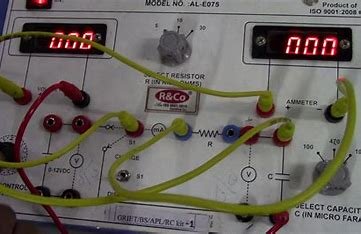
A photographic flash is a device that produces a brief and intense burst of light to illuminate a scene for photography. The flash is usually powered by a capacitor, which stores electrical energy and releases it quickly when triggered. The capacitor is charged by a battery through a resistor, which limits the current flow and prevents overheating. The duration of the flash depends on how fast the capacitor discharges through the flash lamp, which also has some resistance. This process can be modeled by an RC circuit, where R is the resistance of the lamp and C is the capacitance of the capacitor.
Contents
What is an RC Circuit?
An RC circuit is a simple electrical circuit that consists of a resistor (R) and a capacitor (C) connected in series or parallel. A resistor is a component that opposes the flow of electric current and converts some of the electrical energy into heat. A capacitor is a component that stores electric charge and energy in an electric field. When an RC circuit is connected to a voltage source, such as a battery, the capacitor starts to charge up and the current flows through the resistor. As the capacitor charges, the voltage across it increases and the current decreases. The time it takes for the capacitor to charge up to a certain fraction of the source voltage is called the RC time constant, denoted by τ (tau). The RC time constant can be calculated by multiplying the resistance and the capacitance: τ = RC.
How Does an RC Time Constant Affect the Flash Duration?
The duration of a photographic flash is related to the RC time constant of the circuit that powers it. When the flash is triggered, the capacitor starts to discharge through the lamp, producing light. As the capacitor discharges, the voltage across it decreases and the current also decreases. The time it takes for the capacitor to discharge to a certain fraction of its initial voltage is also equal to the RC time constant: τ = RC. Therefore, the longer the RC time constant, the longer the flash duration. Conversely, the shorter the RC time constant, the shorter the flash duration.
The RC time constant depends on both the resistance of the lamp and the capacitance of the capacitor. If either one increases, so does the RC time constant and hence the flash duration. If either one decreases, so does the RC time constant and hence the flash duration. For example, according to bartleby.com, for a certain camera, the RC time constant during flash discharge is 0.115 μs (microseconds), which means that it takes 0.115 μs for the capacitor to discharge to about 37% of its initial voltage. If the resistance of the flash lamp is 0.048 Ω (ohms), then we can calculate that the capacitance of the capacitor is:
C = τ / R
C = 0.115 μs / 0.048 Ω
C = 2.4 μF (microfarads)
If we want to increase or decrease the flash duration, we can change either R or C or both.
How Can We Measure or Control the Flash Duration?
One way to measure or control the flash duration is by using an oscilloscope, which is an instrument that displays voltage signals as waveforms on a screen. By connecting an oscilloscope probe to one terminal of
the capacitor and another probe to ground, we can observe how
the voltage across
the capacitor changes over time when
the flash is triggered.
The oscilloscope will show
a curve that starts from
a high value (the initial voltage of
the capacitor) and drops down exponentially as
the capacitor discharges through
the lamp.
The flash duration can be defined as
the time interval between two points on
the curve that correspond to certain fractions of
the initial voltage, such as 10% and 90%. By measuring this time interval on
the oscilloscope screen, we can estimate
the flash duration.
Another way to control
the flash duration is by using
a thyristor, which is
a semiconductor device that acts like
a switch.
A thyristor can be turned on by applying
a small voltage pulse to its gate terminal, which allows
a large current to flow between its anode and cathode terminals.
A thyristor can be turned off by reducing
the current below
a certain threshold, which blocks
the current flow between its terminals.
By connecting
a thyristor in series with
the capacitor and
the lamp, we can control when
the flash starts and stops by applying or removing
a gate pulse to
the thyristor.
Conclusion
The duration of a photographic flash is related to an RC time constant, which depends on both
the resistance of
the lamp and
the capacitance of
the capacitor.
The longer
the RC time constant, the longer
the flash duration, and vice versa.
The RC time constant can be calculated by multiplying
the resistance and
the capacitance: τ = RC.
The flash duration can be measured or controlled by using
an oscilloscope or
a thyristor.
