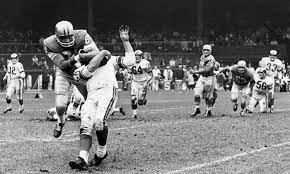
Dick “Night Train” Lane was one of the greatest cornerbacks in NFL history. He played for 14 years in the league, setting records, earning accolades, and striking fear into the hearts of his opponents. He was known for his ferocious tackling, his blazing speed, and his knack for interceptions. He was inducted into the Pro Football Hall of Fame in 1974 and named to the NFL 100th Anniversary All-Time Team in 2019. But how did Night Train Lane die? What was the cause of his death? And what legacy did he leave behind?
Early Life and Career
Lane was born in Austin, Texas, in 1928. He was abandoned by his birth parents, a prostitute and a pimp, when he was only three months old. He was found in a dumpster, covered in newspapers, by a woman named Ella Lane, who adopted him and raised him as her own. Lane had a tough childhood, working odd jobs and getting into trouble. He also developed a love for football, playing with the neighborhood kids and earning the nickname “Cue Ball” after a pool hall incident.
Lane served four years in the Army after high school, where he played football for his base team. He then moved to Los Angeles and worked as a glass cutter at an aircraft plant. One day, he saw the Los Angeles Rams practicing at a nearby field and decided to try out for the team. He walked into the team’s office and asked for a chance to play. To his surprise, he was given a tryout and made the team as an undrafted free agent.
Lane made an immediate impact as a rookie in 1952, setting an NFL record with 14 interceptions in 12 games. He also earned his famous nickname “Night Train” after a teammate noticed that he preferred to travel by train rather than by plane because he was afraid of flying. Lane played for the Rams for two seasons, then joined the Chicago Cardinals in 1954. He led the league in interceptions again that year with 10 and made his first Pro Bowl appearance.
Lane spent six seasons with the Cardinals, establishing himself as one of the best defensive backs in the league. He was selected as a first-team All-Pro four times and made four more Pro Bowls. He was also known for his vicious tackling style, often using his forearm or shoulder to hit opponents around their neck or head. This technique, dubbed the “Night Train Necktie”, was later banned by the NFL.
In 1960, Lane was traded to the Detroit Lions, where he played for the final six years of his career. He continued to excel as a cornerback, making three more Pro Bowls and three more first-team All-Pro selections. He also helped the Lions win three division titles and reach the NFL championship game in 1962. He retired after the 1965 season with 68 career interceptions, which ranked second in NFL history at the time and still ranks fourth as of 2021.
Post-Football Life and Death
After retiring from football, Lane worked for the Detroit Lions in various administrative roles from 1966 to 1972. He then became an assistant coach at Southern University in 1972 and Central State University in 1973. In 1974, he was elected to the Pro Football Hall of Fame in his first year of eligibility.
Lane moved back to Detroit in 1975 and became the director of the city’s Police Athletic League (PAL), a program that provided sports and educational opportunities for underprivileged youth. He held this position for 17 years until he retired in 1992. He also married jazz singer Dinah Washington in 1963, but they divorced after two years. He later married Geraldine Lillian Berry in 1984.
Lane suffered from diabetes and heart problems in his later years. He moved to an assisted living facility in Austin, Texas, in 2000. On January 29, 2002, he died of a heart attack at the age of 73.
Legacy and Impact
Lane is widely regarded as one of the greatest cornerbacks and defensive players of all time. He was named to the NFL 50th Anniversary All-Time Team in 1969, the NFL 75th Anniversary All-Time Team in 1994, and the NFL 100th Anniversary All-Time Team in 2019. He was also ranked number 20 on The Sporting News’ list of the 100 Greatest Football Players in 1999.
Lane is remembered for his record-breaking interceptions, his hard-hitting tackles, and his fearless attitude on the field. He influenced generations of defensive backs who admired his skills and style. He also inspired many young people who faced similar challenges as he did growing up.
Night Train Lane was a football legend who overcame adversity and achieved greatness. His life story is one of courage, perseverance, and excellence. He left a lasting mark on the game and the world. He was a true Hall of Famer, on and off the field.
