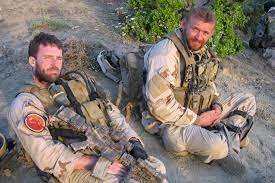
Michael P. Murphy was a United States Navy SEAL officer who was awarded the Medal of Honor, the highest military decoration, for his actions during the War in Afghanistan. He was the first member of the United States Navy to receive the award since the Vietnam War. His heroic act of bravery and selflessness has inspired many people and earned him the respect and admiration of his fellow soldiers and the nation.
Contents
Who was Michael P. Murphy?
Michael P. Murphy was born on May 7, 1976, in Smithtown, New York, to Irish American parents Maureen and Daniel Murphy, a former assistant Suffolk County district attorney and a wounded veteran of the Vietnam War. He was raised in Patchogue, New York, where he attended Saxton Middle School and Patchogue-Medford High School. He was known to his friends as “Murph” and as “The Protector” in his high school years, as he often stood up for the weak and the bullied. He also worked as a lifeguard at the Brookhaven town beach in Lake Ronkonkoma, New York, every summer throughout his college years.
He graduated from Pennsylvania State University in 1998 with a double major in political science and psychology. He was engaged to his college sweetheart, Heather Duggan, and their wedding was scheduled for November 2005. After college, he accepted a commission in the United States Navy and became a United States Navy SEAL in July 2002. He served in SEAL Delivery Vehicle Team One (SDVT-1) and SEAL Team 10, and participated in several War on Terrorism missions.
What was Operation Red Wings?
Operation Red Wings was a counter-insurgency mission in the Kunar Province of Afghanistan, conducted by four members of SEAL Team 10. They were tasked to locate and eliminate a high-ranking Taliban leader named Ahmad Shah, who was responsible for killings of four U.S. Marines, local Afghans, and other coalition forces.
The four-man team consisted of Lieutenant Michael P. Murphy, Petty Officer Second Class Matthew Axelson, Petty Officer Second Class Danny Dietz, and Hospital Corpsman Second Class Marcus Luttrell. They were inserted by helicopter into a remote area of the Hindu Kush mountains on June 27, 2005.
How did Michael P. Murphy die?
On June 28, 2005, the SEAL team was discovered by local goat herders, who were suspected to be Taliban sympathizers. The team decided to let them go, rather than killing them or taking them prisoner, as they were not armed and posed no immediate threat. However, this decision proved to be fatal, as the goat herders alerted the nearby Taliban forces of the team’s presence.
The team soon found themselves surrounded by a large number of Taliban fighters, estimated to be between 30 and 40. The team engaged in a fierce firefight, but they were outnumbered and outgunned. They also faced communication difficulties, as they were in a rugged terrain with limited radio reception.
Murphy, as the team leader, realized that the only way to save his team was to call for backup. He left his cover position and went to a clearing away from the mountains, exposing himself to a hail of gunfire in order to get a clear signal to contact headquarters. He managed to reach the SOF Quick Reaction Force and relayed the dire situation and requested immediate support for his team. He then returned to his cover position to continue fighting, despite being shot several times.
According to sitename Military Wiki, Murphy was killed on June 28, 2005, after he was shot in the back, causing fatal damage to his liver. He was 29 years old.
What was the outcome of Operation Red Wings?
Operation Red Wings resulted in the deaths of 19 U.S. military personnel, including the four SEALs and 16 others who were aboard a MH-47 Chinook helicopter that was shot down by a rocket-propelled grenade while attempting to rescue the team. It was the worst single-day loss of life for the U.S. Navy SEALs and for the U.S. forces in Afghanistan.
The only survivor of the SEAL team was Marcus Luttrell, who was badly wounded and evaded capture for several days, until he was rescued by a local Pashtun tribe, who protected him from the Taliban and contacted the U.S. forces.
The Taliban leader Ahmad Shah was not killed in the operation, but was later killed in a firefight with Pakistani forces in 2008.
How was Michael P. Murphy honored?
Michael P. Murphy was posthumously awarded the Medal of Honor on October 22, 2007, by President George W. Bush, who presented the medal to his parents. He was also awarded the Purple Heart, the Joint Service Commendation Medal, the Navy and Marine Corps Commendation Medal, and several other medals and ribbons.
His name was added to the Pentagon’s Hall of Heroes, and several civilian and military buildings have been named in his honor, including a U.S. Navy ship, a combat training pool, a park, a post office, and a high school campus. A memorial and a veterans plaza were also dedicated to him and the other fallen soldiers of Operation Red Wings at his alma mater, Penn State University.
His story was also depicted in the 2007 book Lone Survivor: The Eyewitness Account of Operation Redwing and the Lost Heroes of SEAL Team 10 by Marcus Luttrell, and the 2013 film Lone Survivor, directed by Peter Berg and starring Taylor Kitsch as Murphy.
Michael P. Murphy is remembered as a hero, a leader, and a protector, who sacrificed his life for his team and his country. His courage and loyalty have inspired many people and earned him the respect and admiration of his fellow soldiers and the nation. He is a true example of the Navy SEAL motto: “The Only Easy Day Was Yesterday.”
