If you have ever wondered what is the difference between weight and mass, or how they are related, this article is for you. In this article, we will explain the basic concepts of weight and mass, how they are measured, how they vary depending on the location, and how to calculate one from the other. We will also provide some examples and diagrams to help you understand better.
What is Mass?
Mass is a measure of the amount of matter in an object. Matter is anything that has mass and takes up space, such as atoms, molecules, and particles. Mass is a fundamental property of the object and does not depend on the external factors, such as gravity or location. Mass is always constant for a given object, unless it undergoes a nuclear reaction or a chemical change that alters its composition.
The SI unit of mass is kilogram (kg), which is defined as the mass of a platinum-iridium cylinder kept at the International Bureau of Weights and Measures in France. Other common units of mass are gram (g), milligram (mg), and tonne (t).
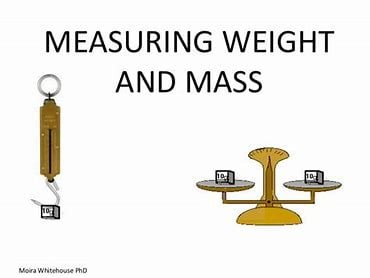
Mass can be measured using a balance, such as a beam balance, a lever balance, or a pan balance. A balance compares the mass of an object with the mass of a known standard or another object. For example, if you place an apple on one side of a beam balance and some weights on the other side, you can find the mass of the apple by adjusting the weights until the beam is balanced.
What is Weight?
Weight is the force of gravity acting on an object. Gravity is the attraction between two objects that have mass, such as the Earth and an apple. The more mass an object has, the more gravity it exerts. The closer two objects are, the stronger the gravity between them.
The SI unit of weight is newton (N), which is defined as the force that causes a mass of one kilogram to accelerate at one meter per second squared. Other common units of weight are pound (lb), ounce (oz), and kilogram-force (kgf).
Weight can be measured using a spring scale, such as a bathroom scale or a luggage scale. A spring scale measures the amount of compression or extension of a spring when an object is attached to it. The more weight an object has, the more it stretches or compresses the spring.
How are Weight and Mass Related?
Weight and mass are related by the following formula:
�=��W=mg
where W is weight, m is mass, and g is the acceleration due to gravity.
The acceleration due to gravity is the rate at which an object falls towards the center of a gravitational field, such as the Earth. The value of g depends on the location and altitude of the object. On Earth, g is approximately 9.8 m/s^2 at sea level, but it decreases as you move away from the center of the Earth. For example, g is about 9.83 m/s^2 at the poles and about 9.78 m/s^2 at the equator.
The formula shows that weight is directly proportional to mass and gravity. This means that if you increase or decrease one of them, you will also increase or decrease the weight by the same factor. For example, if you double your mass, you will also double your weight.
However, this also means that weight can change depending on where you are, while mass remains constant. For example, if you travel from Earth to the Moon, your mass will stay the same, but your weight will decrease significantly because the Moon has much less gravity than Earth. On Earth, your weight would be W = mg = 60 kg x 9.8 m/s^2 = 588 N. On the Moon, your weight would be W = mg = 60 kg x 1.6 m/s^2 = 96 N.
Examples
Let’s look at some examples of how to calculate weight from mass and vice versa.
- Example 1: What is your weight on Earth if your mass is 50 kg?
To find your weight on Earth, we use the formula W = mg and plug in the values:
W = mg
W = 50 kg x 9.8 m/s^2
W = 490 N
Your weight on Earth is 490 N.
- Example 2: What is your mass if your weight on Mars is 150 N?
To find your mass on Mars, we use the formula W = mg and rearrange it to solve for m:
W = mg
m = W/g
We need to know the value of g on Mars, which is about 3.7 m/s^2. Then we plug in the values:
m = W/g
m = 150 N / 3.7 m/s^2
m = 40.54 kg
Your mass on Mars is 40.54 kg.
- Example 3: How much would you weigh on Jupiter if your mass is 70 kg?
To find your weight on Jupiter, we use the formula W = mg and plug in the values:
W = mg
We need to know the value of g on Jupiter, which is about 24.8 m/s^2. Then we plug in the values:
W = 70 kg x 24.8 m/s^2
W = 1736 N
Your weight on Jupiter is 1736 N.
