The Pythagorean theorem and the distance formula are two mathematical concepts that are closely related. In this article, we will explore how they are connected and how they can be used to solve various problems involving distances and coordinates.
Contents
What is the Pythagorean Theorem?
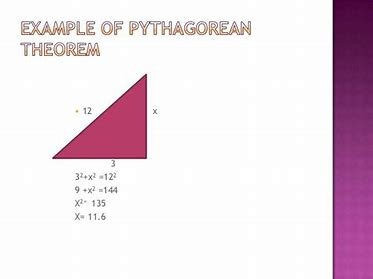
The Pythagorean theorem is a fundamental relation in Euclidean geometry between the three sides of a right triangle. It states that the square of the hypotenuse (the side opposite the right angle) is equal to the sum of the squares of the other two sides. This theorem can be written as an equation relating the lengths of the sides a, b and c, often called the Pythagorean equation:
�2+�2=�2a2+b2=c2
The theorem is named after the Greek philosopher Pythagoras, who is credited with its proof, although it was known by many ancient civilizations before him. The theorem has been proven by many different methods, both geometric and algebraic, and has many applications in mathematics, physics, engineering and other fields.
What is the Distance Formula?
The distance formula is a formula that is used to find the distance between two points in a coordinate plane. The distance formula is derived from the Pythagorean theorem by applying it to a right triangle whose vertices are the two given points and the origin. The distance formula can be used to find the length of any line segment, the perimeter of any polygon, or the area of any shape on a coordinate plane.
The distance formula for two points P (�1,�1)(x1,y1) and Q (�2,�2)(x2,y2) is given by:
�=(�2−�1)2+(�2−�1)2d=(x2−x1)2+(y2−y1)2
where d is the distance between P and Q.
How are They Related?
The Pythagorean theorem and the distance formula are related because they both use the same idea of finding the length of the hypotenuse of a right triangle. The difference is that the Pythagorean theorem uses the lengths of the sides as given, while the distance formula uses the coordinates of the endpoints to calculate them.
To see how they are related, let us consider an example. Suppose we want to find the distance between two points A (3,−4)(3,−4) and B (−5,−1)(−5,−1) on a coordinate plane. We can draw a right triangle ABC with A and B as vertices and C as the point where AB meets the x-axis. Then we can use either the Pythagorean theorem or the distance formula to find AB.
Using the Pythagorean theorem, we first need to find the lengths of AC and BC. We can do this by subtracting the x-coordinates and y-coordinates of A and B respectively:
��=∣�2−�1∣=∣−5−3∣=8AC=∣x2−x1∣=∣−5−3∣=8
��=∣�2−�1∣=∣−1−(−4)∣=3BC=∣y2−y1∣=∣−1−(−4)∣=3
Then we can use the Pythagorean equation to find AB:
��2=��2+��2=82+32=64+9=73AB2=AC2+BC2=82+32=64+9=73
��=73≈8.54AB=73≈8.54
Using the distance formula, we can directly plug in the coordinates of A and B into the formula:
�=(�2−�1)2+(�2−�1)2d=(x2−x1)2+(y2−y1)2
�=(−5−3)2+(−1−(−4))2d=(−5−3)2+(−1−(−4))2
�=64+9=73≈8.54d=64+9=73≈8.54
We can see that we get the same answer using either method. The distance formula is essentially a shortcut for applying the Pythagorean theorem to any pair of points on a coordinate plane.
Conclusion
The Pythagorean theorem and the distance formula are two important tools for finding distances in geometry. They are related by using the same principle of finding the hypotenuse of a right triangle, but with different inputs. The Pythagorean theorem uses the lengths of the sides as inputs, while the distance formula uses the coordinates of the endpoints as inputs. Both methods give us the same output: the distance between two points.
