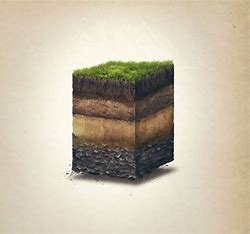
Soil is the thin layer of material that covers most of the Earth’s surface. It is essential for sustaining life, as it provides nutrients, water, and oxygen to plants and animals. Soil also plays a vital role in regulating the climate, filtering water, and storing carbon.
But where does soil come from? How is it formed and maintained? And what is the relationship between soil and bedrock, the hard, solid rock beneath it?
In this article, we will explore these questions and learn more about the fascinating connection between soil and bedrock.
Contents
What is Bedrock?
Bedrock is the relatively hard, solid rock that lies below the soil and other surface materials such as gravel, sand, and sediment. Bedrock can be made of different types of rock, such as granite, limestone, sandstone, or basalt. Bedrock can also vary in depth, thickness, and shape, depending on the geological history and processes of a region.
Bedrock is often exposed on some mountaintops, along rocky coastlines, in quarries, and on plateaus. These visible exposures of bedrock are called outcrops. Outcrops can be formed by natural processes such as erosion or tectonic uplift, or by human activities such as mining or drilling.
Bedrock is important for geology, stratigraphy, and civil engineering. By studying bedrock, scientists can learn about the origin, age, composition, and structure of rocks and how they have changed over time. Bedrock also provides a stable foundation for buildings, bridges, roads, and other structures.
How is Soil Formed from Bedrock?
Soil is formed from bedrock through the process of weathering. Weathering is the physical and chemical breakdown of rocks into smaller particles by natural agents such as water, wind, ice, plants, animals, and humans.
There are two main types of weathering: mechanical and chemical.
Mechanical weathering is the physical disintegration of rocks into smaller pieces by forces such as freezing and thawing, abrasion, impact, or pressure. Mechanical weathering does not change the chemical composition of rocks, but only reduces their size and shape.
Chemical weathering is the chemical alteration of rocks by reactions with water, oxygen, carbon dioxide, acids, or other substances. Chemical weathering changes the chemical composition of rocks by dissolving minerals or forming new ones.
Both mechanical and chemical weathering produce soil particles that are transported by water, wind, ice, or gravity to new locations. These particles accumulate over time and form layers of soil.
The rate and extent of weathering depend on several factors such as climate, vegetation, topography, time, and human activities. Generally speaking,
- Weathering is faster in warm and wet climates than in cold and dry ones.
- Weathering is faster in areas with abundant vegetation than in barren ones.
- Weathering is faster on steep slopes than on flat ones.
- Weathering is faster on exposed bedrock than on covered ones.
- Weathering is faster in areas with frequent human disturbances than in undisturbed ones.
What are the Layers of Soil?
Soil is not a uniform material but a complex mixture of minerals (~45%), organic matter (~5%), air (~25%), and water (~25%). Soil also varies in texture (the relative proportions of sand, silt, and clay), structure (the arrangement of soil particles), color (the reflection of light from soil particles), pH (the acidity or alkalinity of soil), fertility (the ability to supply nutrients to plants), and biodiversity (the variety of living organisms in soil).
Soil can be divided into different layers or horizons based on their physical and chemical characteristics. These horizons are usually arranged from top to bottom as follows:
- O horizon: The topmost layer of soil that consists mainly of organic matter such as dead plants and animals, decomposed by microorganisms. The O horizon provides nutrients and humus (a dark-colored substance that improves soil quality) to the lower layers. The O horizon is also called the litter layer or organic layer.
- A horizon: The layer below the O horizon that consists of a mixture of organic matter and mineral particles. The A horizon is also called the topsoil or surface soil. The A horizon is where most plant roots grow and where most biological activity occurs. The A horizon is usually dark-colored due to the presence of humus.
- E horizon: The layer below the A horizon that consists mainly of mineral particles that have been leached (washed away) by water from the upper layers. The E horizon is also called the eluviation layer or leaching layer. The E horizon is usually light-colored due to the loss of minerals.
- B horizon: The layer below the E horizon that consists mainly of mineral particles that have been enriched by minerals from the upper layers. The B horizon is also called the subsoil or illuviation layer. The B horizon is usually reddish or brownish due to the accumulation of iron and clay.
- C horizon: The layer below the B horizon that consists mainly of partially weathered bedrock fragments. The C horizon is also called the parent material or regolith. The C horizon is usually similar in color and texture to the underlying bedrock.
- R horizon: The bottommost layer of soil that consists of unweathered bedrock. The R horizon is also called the rock layer or bedrock layer. The R horizon is usually hard and solid and has no soil characteristics.
How is Soil Related to Bedrock?
Soil and bedrock are closely related in several ways. Here are some examples:
- Soil is derived from bedrock through weathering. The type and composition of bedrock influence the type and composition of soil. For instance, granite bedrock produces sandy soil, while limestone bedrock produces clayey soil.
- Soil covers and protects bedrock from further weathering and erosion. The thickness and quality of soil affect the rate and extent of bedrock weathering. For instance, thick and fertile soil slows down bedrock weathering, while thin and poor soil speeds up bedrock weathering.
- Soil interacts with bedrock through water movement. Water infiltrates through soil and reaches bedrock, where it can dissolve minerals or create cracks. Water also flows from bedrock to soil, where it can supply nutrients or create springs.
- Soil reflects the history and evolution of bedrock. By studying soil, scientists can infer the origin, age, structure, and changes of bedrock over time. For instance, soil can indicate the presence of ancient volcanoes, glaciers, rivers, or oceans.
Conclusion
Soil and bedrock are two essential components of the Earth’s surface that have a dynamic and interdependent relationship. Soil is formed from bedrock through weathering, but also covers and protects bedrock from further weathering. Soil interacts with bedrock through water movement, and reflects the history and evolution of bedrock.
Understanding the connection between soil and bedrock can help us appreciate the diversity and complexity of our planet, as well as the challenges and opportunities for managing our natural resources.
If you enjoyed this article, please share it with your friends and family. And if you have any questions or comments, please leave them below.
Thank you for reading!
