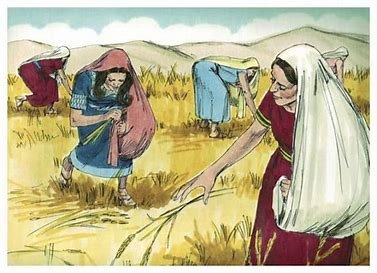
Ruth is one of the most remarkable women in the Bible. She was a Moabite, a foreigner who belonged to a nation that was often at war with Israel. Yet she chose to leave her homeland and follow her mother-in-law Naomi to Bethlehem, where she embraced the God of Israel and the people of God. Ruth’s story is not only a beautiful example of loyalty, kindness and courage, but also a significant part of God’s plan of salvation for the world. Ruth was a direct ancestor of King David and Jesus Christ, the Savior of all nations.
Contents
Ruth’s Journey from Moab to Bethlehem
Ruth’s story begins with a famine in the land of Judah, which forced a family from Bethlehem to migrate to Moab, a neighboring country. The family consisted of Elimelech, his wife Naomi, and their two sons Mahlon and Kilion. In Moab, Elimelech died, leaving Naomi a widow. Her sons married two Moabite women, Ruth and Orpah. After about ten years, both Mahlon and Kilion also died, leaving Naomi and her daughters-in-law childless and destitute.
Naomi decided to return to her homeland, since she heard that the Lord had blessed Judah with food again. She urged her daughters-in-law to stay in Moab and find new husbands among their own people. Orpah agreed, but Ruth refused to leave Naomi. She made a famous declaration of devotion that has become a model of commitment for many:
> “Don’t urge me to leave you or to turn back from you. Where you go I will go, and where you stay I will stay. Your people will be my people and your God my God. Where you die I will die, and there I will be buried. May the Lord deal with me, be it ever so severely, if anything but death separates you and me.” (Ruth 1:16-17)
Ruth’s words show that she had faith in the God of Israel, whom she had learned to know through Naomi. She was willing to leave behind her family, culture and religion to follow Naomi and worship the true God. Naomi saw Ruth’s determination and accepted her as her companion. Together they traveled to Bethlehem, where they arrived at the beginning of the barley harvest.
Ruth’s Encounter with Boaz
Naomi and Ruth faced a difficult situation in Bethlehem. They had no means of support and no male relatives to protect them. Ruth decided to go to the fields and glean the leftover grain that the harvesters had missed or dropped, as was allowed by the law of Moses for the poor and the foreigners (Leviticus 19:9-10). As it happened, she came to the field of Boaz, a wealthy landowner who was also a relative of Elimelech.
Boaz noticed Ruth among the workers and asked about her identity. He learned that she was Naomi’s daughter-in-law who had come from Moab. He was impressed by her loyalty and her faith in God. He spoke kindly to her and told her to stay in his field, where she would be safe and well-provided. He also instructed his men not to harass her or hinder her from gleaning.
Ruth was amazed by Boaz’s generosity and grace. She bowed down before him and asked why he had shown such favor to her, a foreigner. Boaz replied:
> “I’ve been told all about what you have done for your mother-in-law since the death of your husband–how you left your father and mother and your homeland and came to live with a people you did not know before. May the Lord repay you for what you have done. May you be richly rewarded by the Lord, the God of Israel, under whose wings you have come to take refuge.” (Ruth 2:11-12)
Boaz invited Ruth to share his meal with him and gave her roasted grain to eat. He also told his workers to deliberately leave some stalks of grain for her to pick up. Ruth continued to glean in Boaz’s field until the end of the harvest season. She brought home what she had gathered and shared it with Naomi.
Naomi was delighted by Ruth’s success and praised God for his provision. She recognized Boaz as one of their kinsman-redeemers, a close relative who had the obligation and the right to help them in their distress (Leviticus 25:25-55). She devised a plan to secure Ruth’s future by seeking a marriage proposal from Boaz.
Ruth’s Proposal to Boaz
Naomi instructed Ruth to wash herself, put on perfume and dress in her best clothes. She told her to go to the threshing floor where Boaz would be winnowing barley that night. She said to Ruth:
> “When he lies down, note the place where he is lying. Then go and uncover his feet and lie down. He will tell you what to do.” (Ruth 3:4)
Ruth agreed to do everything that Naomi had told her. She went to the threshing floor and waited until Boaz had finished eating and drinking and had fallen asleep. Then she quietly approached him, uncovered his feet and lay down.
At midnight, Boaz was startled and woke up. He found a woman lying at his feet and asked who she was. Ruth answered:
> “I am your servant Ruth. Spread the corner of your garment over me, since you are a kinsman-redeemer.” (Ruth 3:9)
Ruth’s words were a bold but respectful request for Boaz to marry her and take her under his protection. She used the same expression that Boaz had used earlier to describe God’s care for her: “under whose wings you have come to take refuge” (Ruth 2:12). She appealed to Boaz’s duty and kindness as a kinsman-redeemer.
Boaz was moved by Ruth’s proposal. He praised her for her noble character and her loyalty to Naomi. He said to her:
> “The Lord bless you, my daughter. This kindness is greater than that which you showed earlier: You have not run after the younger men, whether rich or poor. And now, my daughter, don’t be afraid. I will do for you all you ask. All the people of my town know that you are a woman of noble character.” (Ruth 3:10-11)
Boaz agreed to marry Ruth, but he told her that there was a problem. There was another relative who was closer than him who had the first right to redeem Naomi’s land and marry Ruth. Boaz said that he would go to him in the morning and ask him if he was willing to do so. If not, Boaz promised to redeem Ruth himself.
Boaz gave Ruth six measures of barley to take home to Naomi. He told her not to let anyone know that she had been at the threshing floor. Ruth returned to Naomi and told her everything that had happened. Naomi assured her that Boaz would not rest until he had settled the matter.
Ruth’s Redemption by Boaz
The next day, Boaz went to the town gate, where legal transactions were conducted in the presence of witnesses. He summoned the other kinsman-redeemer and ten elders of the town. He told them that Naomi had returned from Moab and was selling a piece of land that belonged to Elimelech. He asked the other relative if he wanted to buy it.
The man said that he would redeem it. Then Boaz added that whoever bought the land would also have to marry Ruth, the Moabite widow of Elimelech’s son, in order to maintain the family name and inheritance. The man changed his mind and said that he could not redeem it, because it would endanger his own estate. He gave his right of redemption to Boaz.
Boaz announced to the elders and all the people:
> “Today you are witnesses that I have bought from Naomi all the property of Elimelech, Kilion and Mahlon. I have also acquired Ruth the Moabite, Mahlon’s widow, as my wife, in order to maintain the name of the dead with his property, so that his name will not disappear from among his family or from his hometown. Today you are witnesses!” (Ruth 4:9-10)
The elders and all the people blessed Boaz and Ruth, saying:
> “We are witnesses. May the Lord make the woman who is coming into your home like Rachel and Leah, who together built up the family of Israel. May you have standing in Ephrathah and be famous in Bethlehem. Through the offspring the Lord gives you by this young woman, may your family be like that of Perez, whom Tamar bore to Judah.” (Ruth 4:11-12)
Boaz married Ruth and she became his wife. The Lord enabled her to conceive and she gave birth to a son. The women of Bethlehem rejoiced with Naomi and said:
> “Praise be to the Lord, who this day has not left you without a kinsman-redeemer. May he become famous throughout Israel! He will renew your life and sustain you in your old age. For your daughter-in-law, who loves you and who is better to you than seven sons, has given him birth.” (Ruth 4:14-15)
Naomi took care of the child as if he were her own son. She named him Obed, which means “servant” or “worshiper”. Obed grew up and became the father of Jesse, who was the father of David, the greatest king of Israel.
