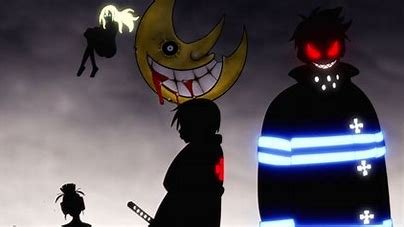
Fire Force and Soul Eater are two anime series that have captivated fans with their unique blend of action, comedy, and supernatural elements. But did you know that they are actually connected in more ways than one? In this article, we will explore how Fire Force is a prequel to Soul Eater, and how the author of both series, Atsushi Ohkubo, planned this connection from the very start.
Contents
The Same Creator, The Same Style
The first and most obvious link between Fire Force and Soul Eater is that they were both created by the same manga artist, Atsushi Ohkubo. Ohkubo started his career in 2001 with B.Ichi, a four-volume series about a boy who can control bugs. He then moved on to Soul Eater in 2004, which became his most successful work to date. Soul Eater is set in an academy where a Shinigami (death god) trains humans to become wielders and weapon meisters, who can transform into weapons and fight evil souls.
Soul Eater ran for 113 chapters until 2013, and was adapted into a 51-episode anime series in 2008. It gained a huge fanbase for its quirky characters, dark humor, and stylish action scenes. Ohkubo’s distinctive art style, which features exaggerated expressions, sharp angles, and dynamic poses, also contributed to the appeal of Soul Eater.
In 2015, Ohkubo launched his next series, Fire Force. Fire Force is the story of Shinra Kusakabe and a group of pyrokinetic firefighters who can fight fires and manipulate fire. They belong to the Special Fire Force Company 8, which investigates the mysterious phenomenon of spontaneous human combustion, which turns people into flaming creatures called Infernals.
Fire Force has been serialized for 283 chapters until 2021, and has been adapted into an ongoing anime series since 2019. It has also attracted a large following for its thrilling plot, colorful characters, and spectacular fire effects. Ohkubo’s art style has evolved over the years, but he still retains his signature flair and flair for Soul Eater.
The Moon Connection
The second and more subtle link between Fire Force and Soul Eater is the appearance of the moon. The moon is an iconic element in Soul Eater, as it has a creepy grin that reflects the mood of the story. The moon also plays a role in the plot, as it is the source of madness waves that affect the characters’ sanity.
In Fire Force, the moon also has a grin, but it is not as prominent as in Soul Eater. However, it still hints at a connection between the two worlds. In fact, some fans speculated that Fire Force was either a prequel or a sequel to Soul Eater based on the moon alone.
The World-Building Twist
The third and most surprising link between Fire Force and Soul Eater is revealed in the final chapter of Fire Force. It turns out that Fire Force is indeed a prequel to Soul Eater, but not in a conventional way. Instead of being set in the same timeline or universe, Fire Force is actually the origin story of how Soul Eater’s world came to be.
The main antagonist of Fire Force is the Evangelist Haumea, who leads the Holy Sol Religion, a cult that worships life and God. She plans to use the eight Pillars, people who have a connection to Adolla, a parallel dimension where God resides, to trigger another Great Cataclysm that would destroy the world and create a new one in God’s image.
Shinra Kusakabe is one of the Pillars, and he opposes Haumea’s scheme. He decides that the only way to stop her is to change the world himself. He uses his Adolla Burst power to rewrite reality and create a new world that is opposite to Haumea’s vision. Instead of a world that values life, he creates a world that values death. He also creates Death himself, who would later become the Shinigami from Soul Eater.
Shinra explains his reasoning as follows: “When I rebuilt the world, I lessened the value of life.” He adds that he made the world more “absurd” so that people would not spontaneously combust anymore. Instead of combustion, other supernatural phenomena would occur, such as zombies or soul resonance.
The last scene of Fire Force shows Shinra looking at his new creation: the world of Soul Eater. We also see younger versions of Soul and Maka, the main characters of Soul Eater. They are about to enroll in Death Weapon Meister Academy (DWMA), the school founded by Death to train weapon meisters and their partners. The final panel shows Death himself, smiling and welcoming the new students.
The Author’s Plan
According to Ohkubo, the connection between Fire Force and Soul Eater was his plan from the very beginning. He revealed this in an interview with Anime News Network, where he said:
“I had the idea for Fire Force before I started Soul Eater. I wanted to draw a manga about firefighters, but I thought it would be too difficult to make it interesting. So I decided to draw Soul Eater first, and then use the experience and skills I gained from it to draw Fire Force. I also thought it would be fun to connect the two stories in some way.”
Ohkubo also said that he wanted to end Fire Force with a twist that would surprise the readers. He said:
“I wanted to end Fire Force with a big impact, something that would make the readers go ‘What?!’ I thought that making Fire Force a prequel to Soul Eater would be a good way to do that. I also wanted to show my gratitude to the fans of Soul Eater, who supported me for a long time.”
Ohkubo also hinted that he might draw another series in the future that would be connected to Fire Force and Soul Eater. He said:
“I don’t have any concrete plans yet, but I have some ideas for a new series. It might be related to Fire Force and Soul Eater, or it might be something completely different. I want to challenge myself and try new things.”
Conclusion
Fire Force and Soul Eater are two anime series that share more than just a creator. They are also connected by a clever twist that reveals how one world gave birth to another. This connection adds more depth and meaning to both stories, and shows how Ohkubo’s imagination and creativity are truly impressive.
If you are a fan of Fire Force and Soul Eater, you might want to rewatch or reread both series and look for clues and references that foreshadow their connection. You might also want to keep an eye out for Ohkubo’s next work, which might surprise you once again.
