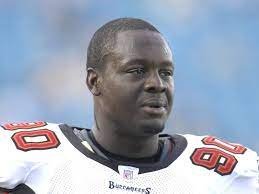
Gaines Adams was a promising young defensive end who played for the Tampa Bay Buccaneers and the Chicago Bears in the National Football League (NFL). He was a unanimous All-American at Clemson University and the fourth overall pick in the 2007 NFL Draft. He had a bright future ahead of him, but his life was cut short by a tragic and unexpected event. On January 17, 2010, Adams died of cardiac arrest caused by an undetected heart condition. He was only 26 years old.
A Sudden and Shocking Loss
Adams was at his home town of Greenwood, South Carolina, when he collapsed and stopped breathing. His family called 911 and tried to revive him, but it was too late. He was pronounced dead at the hospital. A preliminary autopsy revealed that he had an enlarged heart, a condition that can lead to heart failure or irregular heartbeat. According to the coroner, Adams had no history of heart problems and no signs of drug use or trauma. His death was ruled as natural.
The news of Adams’ death stunned his teammates, coaches, and fans. He was remembered as a talented, hard-working, and humble player who had a positive impact on everyone around him. He was also a devoted son, brother, and friend who loved his family dearly. His former coach at Clemson, Tommy Bowden, said that Adams was “one of the most gifted athletes I ever coached” and “a very unselfish, team player”. His former coach at Tampa Bay, Raheem Morris, said that Adams was “a true team guy and a positive influence to everyone he met”. His former coach at Chicago, Lovie Smith, said that Adams was “a great person who had a lot of potential”.
A Hidden and Deadly Condition
Adams’ death raised awareness about the dangers of an enlarged heart, also known as cardiomegaly. This condition can be caused by various factors, such as high blood pressure, heart valve problems, infections, genetic disorders, or excessive exercise. It can also be asymptomatic, meaning that it does not cause any noticeable symptoms. However, it can increase the risk of serious complications, such as heart failure, arrhythmia, blood clots, or sudden cardiac death.
According to the American Heart Association, an enlarged heart can be diagnosed by a physical exam, an electrocardiogram, a chest X-ray, an echocardiogram, or a cardiac MRI. The treatment depends on the underlying cause and the severity of the condition. Some possible treatments include medications, surgery, implantable devices, or lifestyle changes. The prognosis varies depending on the individual case, but some people can live a normal life with an enlarged heart.
A Legacy of Inspiration
Adams’ death was a tragic loss for the NFL and the sports world, but it also inspired many people to honor his memory and legacy. His family donated his organs to help save other lives. His former teams and colleges paid tribute to him by wearing his number or his initials on their helmets or jerseys. His fans and friends organized fundraisers and events to support his foundation, which provides scholarships and mentoring to young athletes. His story also motivated many people to get screened for heart conditions and to raise awareness about the importance of heart health.
Adams was a remarkable player and person who left a lasting impression on everyone who knew him. He was a star on the field and a hero off the field. He was a leader, a role model, and a friend. He was a son, a brother, and a teammate. He was Gaines Adams, and he will never be forgotten.
