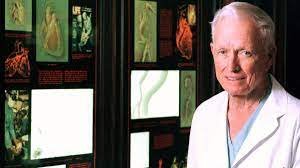
Denton Cooley was a legendary figure in the field of cardiac surgery, who performed many groundbreaking operations and saved countless lives. He was the first to implant an artificial heart in a human, the first to perform a successful heart transplant in the US, and the founder of the Texas Heart Institute. He was also a pioneer in the treatment of aortic aneurysms, heart valves, and congenital heart defects. He was admired for his skill, speed, and innovation, as well as his generosity and humility. He died on November 18, 2016, at the age of 96, leaving behind a legacy of excellence and a lasting impact on the medical world.
Contents
The Early Life and Career of Denton Cooley
Denton Cooley was born on August 22, 1920, in Houston, Texas. He was interested in surgery from a young age, and attended the University of Texas at Austin, where he majored in zoology and played on the basketball team. He then went to the University of Texas Medical Branch in Galveston, where he graduated in 1944. He completed his surgical training and internship at the Johns Hopkins School of Medicine in Baltimore, Maryland, where he worked with Dr. Alfred Blalock, the pioneer of the “Blue Baby” operation, which corrected a congenital heart defect that caused cyanosis, or blueness of the skin. Cooley assisted Blalock in the first such operation in 1944, which marked the birth of cardiac surgery. He also learned from Blalock’s surgical technician, Vivien Thomas, and pediatric cardiologist Helen Taussig, who were instrumental in developing the procedure.
In 1946, Cooley served in the Army Medical Corps and was stationed in Linz, Austria, where he was the chief of surgical services. He returned to Johns Hopkins in 1948, where he became an instructor in surgery. In 1950, he went to London to work with Russell Brock at the Royal Brompton Hospital, where he learned new techniques for repairing heart valves and treating coronary artery disease. He then returned to Houston in 1951, where he became an associate professor of surgery at Baylor College of Medicine and worked at its affiliate institution, The Methodist Hospital. He also began working with Dr. Michael DeBakey, another renowned cardiac surgeon, who was his mentor and colleague. Together, they developed a new method of removing aortic aneurysms, which are bulging weak spots in the wall of the artery that can rupture and cause death. They also co-developed the first heart-lung machine in 1955, which allowed surgeons to operate on the heart while it was stopped and bypassed by a machine that oxygenated and circulated the blood.
The Breakthroughs and Controversies of Denton Cooley
In 1960, Cooley moved his practice to St. Luke’s Episcopal Hospital, where he continued to teach at Baylor. In 1962, he founded the Texas Heart Institute, a private, non-profit institution dedicated to research, education, and patient care in cardiovascular diseases. He also assembled a team of surgeons, nurses, technicians, and researchers, who helped him perform many innovative and challenging operations. He was known for his speed and precision, as well as his willingness to take risks and try new things. He performed as many as 25 heart operations in a single day, and over 100,000 open-heart surgeries in his career.
Some of his most notable achievements include:
- In 1962, he performed the first repair of an aortic aneurysm using a synthetic graft, which he had designed himself.
- In 1968, he performed the first human heart transplant in the US, and the third in the world, after Christiaan Barnard of South Africa and Norman Shumway of Stanford. The patient, Everett Thomas, survived for 204 days, which was a record at the time.
- In 1969, he performed the first implantation of an artificial heart in a human, using a device developed by Domingo Liotta and Akutsu Tetsuzo. The patient, Haskell Karp, was suffering from end-stage heart failure and had no other options. The artificial heart kept him alive for three days, until a donor heart was available and transplanted. However, the patient died of pneumonia 36 hours later. This operation caused a major controversy, as Cooley had not obtained permission from the Food and Drug Administration, nor from his colleague DeBakey, who claimed that Cooley had stolen the device from his laboratory. This led to a bitter feud between the two surgeons, which lasted for 40 years, until they reconciled in 2007.
- In 1978, he performed the first clinical implant of a left ventricular assist device, or LVAD, which is a mechanical pump that helps the heart pump blood. The device was developed by Robert Jarvik and was used as a bridge to transplant for patients waiting for a donor heart.
The Legacy and Death of Denton Cooley
Cooley was widely recognized and honored for his contributions to cardiac surgery and medicine. He received numerous awards, including the Presidential Medal of Freedom, the National Medal of Technology and Innovation, the Lasker Award, and the Rene Leriche Prize. He was also a member of the National Academy of Sciences, the Institute of Medicine, and the American Academy of Arts and Sciences. He authored or co-authored over 1,400 scientific articles and 12 books, and trained over 800 surgeons from around the world. He was also a generous philanthropist, who supported various causes, such as education, arts, and sports. He donated $750,000 to the Johns Hopkins School of Medicine, where he graduated, to build the Denton A. Cooley Recreation Center, which opened in 1981. He also established the Denton A. Cooley Cardiovascular Surgical Foundation in 1972, which is an organization of surgeons trained by him.
Cooley died on November 18, 2016, at his home in Houston, surrounded by his family. He had been in declining health for the past year, but had continued to work at the Texas Heart Institute as its president emeritus. He was survived by his wife of 67 years, Louise Goldsborough Thomas, and their five daughters, 16 grandchildren, and 17 great-grandchildren. He was also mourned by his colleagues, students, patients, and admirers, who remembered him as a visionary, a leader, a teacher, and a friend. He was buried at Glenwood Cemetery in Houston, next to his parents and his brother.
Denton Cooley was a remarkable man, who changed the course of cardiac surgery and medicine. He was a pioneer, an innovator, and a master of his craft. He was also a humble, kind, and compassionate human being, who cared deeply for his family, his patients, and his community. He left behind a legacy of excellence and a lasting impact on the medical world. He was, as one of his colleagues said, “the greatest heart surgeon who ever lived.”
