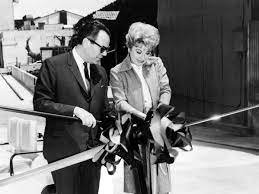
Charles Bluhdorn was a visionary industrialist who transformed a small auto parts company into a sprawling conglomerate that owned Paramount Pictures, Simon & Schuster, and many other businesses. He was known for his ambitious acquisitions, his flamboyant personality, and his involvement in Hollywood. But his life was cut short by a sudden heart attack in 1983, leaving behind a legacy of both success and controversy.
Early Life and Career
Bluhdorn was born in Vienna, Austria, in 1926 to a Jewish family. He emigrated to the United States in 1942 and served in the U.S. Army Air Corps during World War II. He studied at City College of New York and Columbia University before entering the export-import business. In 1956, he bought an interest in Michigan Plating and Stamping, a small automobile component manufacturer. He merged it with a Houston automotive parts distribution firm in 1958 and named it Gulf+Western Industries
Bluhdorn was the chairman and CEO of Gulf+Western from its inception. He expanded the company through a series of acquisitions, diversifying into various industries such as apparel, consumer products, financial services, leisure time, manufacturing, natural resources, and building products. He also acquired media and entertainment assets such as Stax Records, Sega, and Madison Square Garden
One of his most notable acquisitions was Paramount Pictures, which he bought in 1966 for $125 million. He appointed Frank Yablans as president and Robert Evans as head of production, who oversaw the production of hit films such as The Godfather, The Godfather Part II, and Chinatown. Bluhdorn became a prominent figure in Hollywood, mingling with celebrities and influencing the creative decisions of the studio. He was also known for his lavish lifestyle, owning a private jet, a yacht, and a resort in the Dominican Republic
Cause of Death and Legacy
On February 19, 1983, Bluhdorn died of a heart attack at the age of 56. He was on his corporate jet returning from his resort in the Dominican Republic to New York City. He had been suffering from high blood pressure and diabetes, and had been warned by his doctors to slow down his hectic pace. His death was a shock to the business world and to his family and friends
Bluhdorn left behind a mixed legacy. On one hand, he was praised for his entrepreneurial spirit, his vision, and his achievements. He built Gulf+Western into a Fortune 500 company with revenues of over $10 billion in 1981. He also revitalized Paramount Pictures and made it the number one studio in Hollywood. He was honored with awards and recognitions from various organizations and institutions
On the other hand, he was criticized for his aggressive and ruthless tactics, his lack of focus, and his mismanagement. He faced lawsuits, investigations, and scandals over his business dealings and his personal affairs. He also alienated many of his associates and employees with his temper and his demands. He was accused of overpaying for his acquisitions, neglecting his core businesses, and saddling Gulf+Western with debt and inefficiency. He was also blamed for ruining some of his media and entertainment properties with his interference and his lack of taste
Bluhdorn’s death marked the end of an era in corporate America and in Hollywood. His successor, Martin Davis, began to sell off many of Gulf+Western’s assets and restructured the company into a more focused and profitable entity. Paramount Pictures was sold to Viacom in 1994, and Gulf+Western was renamed Paramount Communications in 1989. In 1994, it was acquired by Viacom, which later merged with CBS
Bluhdorn’s story was depicted in books, documentaries, and films, such as The Kid Stays in the Picture, The Godfather Part III, and The Bonfire of the Vanities. He was portrayed by actors such as James Woods, Eli Wallach, and Bruce Willis. He remains a fascinating and controversial figure in the history of business and entertainment
