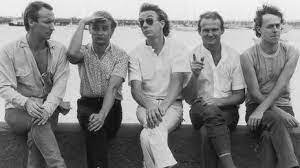
Greg Ham was a talented musician, songwriter, and actor, best known as a member of the Australian band Men at Work. He played saxophone, flute, organ, piano, and synthesizer, and sang lead vocals on some of the band’s songs. He also performed the iconic flute riff in the hit song “Down Under”, which topped the charts in several countries in the early 1980s. But his life and career were marred by a legal dispute over the flute melody, which was found to infringe the copyright of a children’s song. Ham died in 2012 at his home in Melbourne, under mysterious and tragic circumstances.
Early Life and Career
Ham was born in Melbourne on 27 September 1953 and attended Camberwell Grammar School from 1964 to 1971. According to the school’s year books, he was remembered for his acting talent in school plays, as well as his musical abilities. In 1972, he met Colin Hay, who would become his lifelong friend and bandmate, through a mutual friend. In 1979, he joined the original lineup of Men at Work, along with Hay, Ron Strykert, and Jerry Speiser. The band rose to fame with their debut album Business as Usual, which sold over 15 million copies worldwide and featured the singles “Who Can It Be Now?” and “Down Under”. Ham played saxophone, keyboards, flute, and harmonica for the group, as well as performing backing vocals. He sang lead vocals on songs such as “Helpless Automaton” and “I Like To”. In 1983, Ham, as a member of Men at Work, won a Grammy Award for Best New Artist.
Lawsuit and Plagiarism Accusation
In 2009, music publisher Larrikin Music, which owned the rights to the 1930s children’s song “Kookaburra”, sued Men at Work and their record label EMI for plagiarism, alleging that the flute riff in “Down Under” copied the nursery rhyme. The Federal Court of Australia ruled in 2010 that “Down Under” did infringe the copyright of “Kookaburra” and awarded Larrikin 5% of the song’s royalties backdated to 2002. Several appeals by EMI and Men at Work were unsuccessful.
Ham always denied stealing the flute melody and said he was deeply affected by the judgment and felt it tarnished his reputation. He said in an interview with The Age newspaper: “I’m terribly disappointed that that’s the way I’m going to be remembered – for copying something.” He also said that he feared losing his house and his income due to the legal costs and the reduced royalties. He said that he felt “betrayed” by Larrikin Music, which had bought the rights to “Kookaburra” in 1990 for $6,100. He said that he had always considered “Kookaburra” as a traditional song that belonged to the Australian culture.
Death and Legacy
Ham was found dead at his home in Carlton North, Melbourne, on 19 April 2012, by two friends who had not heard from him for about a week. He was 58 years old. The police established a crime scene and investigated the death as suspicious, as there were some “unexplained issues” relating to the case. A postmortem examination was conducted to determine the cause of death, but the results were not made public. Some reports suggested that Ham had died of a heart attack, while others claimed that he had been battling depression and drug addiction.
Ham’s death was mourned by his family, friends, fans, and fellow musicians. Colin Hay, his childhood friend and bandmate, said that he was “a great, great friend and a great guy” who was a “very inspired and instinctive” musician. He also said that he hoped that Ham would be remembered for his musical contributions and not for the plagiarism controversy. Ham left behind two children, Camille and Max.
Ham’s flute riff in “Down Under” remains one of the most recognizable and popular melodies in Australian music history. The song is considered an unofficial anthem of Australia and a symbol of its culture and identity. Ham’s other musical works with Men at Work and as a solo artist also showcase his versatility and creativity as a musician. Ham’s legacy lives on in the hearts and minds of his fans and admirers, who remember him as a talented and passionate artist who brought joy and inspiration to many.
