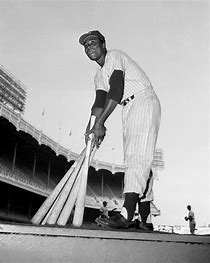
Elston Howard was a baseball player who made history as the first African American to play for the New York Yankees and the first black player to win the American League MVP award. He was also a 12-time All-Star, a six-time World Series champion, and a respected coach and executive. He died at the age of 51 on December 14, 1980, after suffering from heart failure. This article will explore his life and legacy, and how he overcame racial barriers and health challenges to become one of the most beloved Yankees of all time.
Contents
Early Years and Negro Leagues Career
Elston Gene Howard was born on February 23, 1929, in St. Louis, Missouri, to Travis Howard and Emaline Hill. His parents divorced when he was six years old, and his mother remarried. He attended Vashon High School, where he excelled in sports, especially football and baseball. He turned down college football scholarship offers from Illinois, Michigan, and Michigan State to pursue a career in baseball.
In 1948, at the age of 19, he signed with the Kansas City Monarchs of the Negro American League, where he played as an outfielder for three seasons. He was managed by Buck O’Neil, and roomed with future Hall of Famer Ernie Banks. He also served in the U.S. Army during the Korean War from 1951 to 1952.
Breaking the Color Barrier with the Yankees
In 1950, the New York Yankees purchased Howard’s contract from the Monarchs, along with another player, Frank Barnes. They assigned him to the Muskegon Clippers, their farm team in the Central League. He spent five years in the minor leagues, playing various positions, before making his major league debut on April 14, 1955, as a left fielder. He became the first black player to wear the Yankees uniform, eight years after Jackie Robinson had broken the color barrier with the Brooklyn Dodgers.
Howard faced racial discrimination and hostility from some fans, opponents, and even teammates, but he handled it with dignity and grace. He also received support and mentorship from some of the Yankees’ stars, such as Yogi Berra, Mickey Mantle, and Whitey Ford. He quickly established himself as a valuable and versatile player, who could play catcher, outfield, and first base. He also had a powerful bat and a strong arm.
Achievements and Awards
Howard played for the Yankees from 1955 to 1967, and was part of one of the most dominant teams in baseball history. He won six World Series titles with the Yankees, in 1956, 1958, 1961, 1962, 1977, and 1978. He also made 12 All-Star appearances, nine of them as a catcher, even though he had to compete with his teammate Berra, who was also a Hall of Fame catcher. He won two Gold Glove Awards for his defensive excellence in 1963 and 1964.
His best season was in 1963, when he hit .287 with 28 home runs and 85 RBIs, and led the Yankees to the pennant. He was named the American League MVP, becoming the first black player in AL history to win the honor. He also set several records as a catcher, such as the highest fielding percentage (.993), the most putouts (970), and the most total chances (1,008) in a season.
Howard was also an innovator and a leader. He was the first player to use a weighted bat in the on-deck circle, and the first to wear a protective helmet in the field. He was also a respected voice in the clubhouse, who helped younger players and mediated conflicts. He was nicknamed “Ellie” by his teammates, and was known for his calm and friendly demeanor.
Later Years and Death
In 1967, Howard was traded to the Boston Red Sox, where he played for two seasons. He helped the Red Sox win the pennant in 1967, but his performance declined due to injuries and age. He retired after the 1968 season, with a career batting average of .274, 167 home runs, and 762 RBIs.
He rejoined the Yankees as a coach in 1969, becoming the first black coach in the American League. He served as a first base coach, a bullpen coach, and a catching instructor for 11 years, until 1979. He also worked as an administrative assistant to the Yankees’ owner, George Steinbrenner. He was considered a potential candidate to become the first black manager in baseball, but he never got the opportunity.
Howard suffered from heart disease for the last two years of his life. He had a heart attack in 1979, and underwent a bypass surgery. He was hospitalized again in December 1980, and died of heart failure on December 14, at the age of 51. He was survived by his wife, Arlene, and his three children, Cheryl, Karen, and Elston Jr.
Legacy and Honors
Howard was widely mourned and praised by the baseball community and the public. He was remembered as a pioneer, a champion, and a gentleman. Steinbrenner said, “We have lost a dear friend and vital part of our organization. If indeed humility is a trademark of many great men – with that as a measure, Ellie was one of the truly great Yankees.”
Howard was posthumously honored by the Yankees, who retired his number 32 in 1984, and dedicated a plaque to him in Monument Park in 1989. He was also inducted into the St. Louis Sports Hall of Fame in 2009, and the Missouri Sports Hall of Fame in 2013. He received the Pride of the Yankees Award in 1980, and the Willie, Mickey, and the Duke Award in 1999.
Howard is regarded as one of the best catchers and clutch hitters of his era, and one of the most beloved Yankees of all time. He is also recognized as a trailblazer and a role model for African American players and coaches. He paved the way for future stars such as Reggie Jackson, Willie Randolph, and Derek Jeter, who also wore the number 32 before switching to number 2.
According to Wikipedia, Howard’s lifetime fielding percentage of .993 as a catcher was a major league record from 1967 to 1973, and he retired among the AL career leaders in putouts (7th, 6,447) and total chances (9th, 6,977). According to The Washington Post, he was the first black player to win the AL MVP award in 1963. According to UPI, he was the first black player to play for the Yankees in 1955. According to ODMP, he was not related to Officer Elston Morris Howard, who was killed in the line of duty in 2001.
