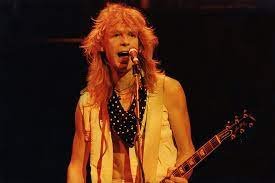
Steve Clark was one of the most talented and influential guitarists of his generation. He was the principal songwriter and lead guitarist for the British hard rock band Def Leppard, until his tragic death in 1991 at the age of 30. He was known for his catchy riffs, melodic solos, and creative songwriting that helped shape the sound and style of Def Leppard and the genre of glam metal. He was also a charismatic and energetic performer who captivated audiences with his passion and skill on stage. He was nicknamed “The Riffmaster” and “Steamin’ Clark” by his fans and peers, and was ranked No. 11 on Classic Rock Magazine’s “100 Wildest Guitar Heroes” .
However, behind his success and fame, Clark struggled with a serious alcohol addiction that affected his health, relationships, and career. He tried to cope with the pressures and challenges of being a rock star by drinking excessively, often to the point of blacking out or passing out. He also abused prescription drugs such as painkillers and antidepressants, which he mixed with alcohol to enhance their effects. He suffered from depression, anxiety, and low self-esteem, and felt isolated and lonely despite being surrounded by people. He attempted to quit drinking several times, but always relapsed. He was unable to control his addiction, which eventually led to his untimely death.
The Night Before His Death
On January 7, 1991, Clark spent the night drinking with his friend Daniel Van Alphen at a local pub in London. They returned to Clark’s home around midnight and watched a video. Van Alphen later testified that Clark seemed “happy and relaxed” that night, and that they did not consume any drugs other than alcohol . Van Alphen fell asleep on the couch, while Clark went to his bedroom.
The next morning, Van Alphen woke up and found Clark lying on another couch in the living room. He thought Clark was sleeping, so he left him alone and went to make some coffee. When he came back, he noticed that Clark was not breathing and had no pulse. He called for an ambulance, but it was too late. Clark was pronounced dead at the scene.
The Cause of Death
The coroner’s report revealed that Clark died of respiratory failure due to a compression of the brain stem caused by excess quantities of alcohol mixed with antidepressants and painkillers . The report stated that Clark had a blood alcohol level of 0.30%, which is three times the legal limit for driving in the UK. He also had traces of morphine, codeine, diazepam, temazepam, and paracetamol in his system. The combination of these substances depressed his central nervous system and stopped his breathing. The coroner ruled his death as accidental, with no evidence of suicidal intent.
The Aftermath
Clark’s death shocked and saddened his family, friends, bandmates, and fans. He was buried at Wisewood Cemetery in Sheffield, near his family home. His funeral was attended by hundreds of people, including his fellow Def Leppard members Joe Elliott, Phil Collen, Rick Savage, and Rick Allen. They paid tribute to their friend and colleague by playing some of his favorite songs at the service.
Def Leppard decided to continue as a four-piece band after Clark’s death, dedicating their next album Adrenalize to his memory. They also recorded a song called “White Lightning” as a homage to Clark, referring to his nickname “Steamin’”. They later hired Vivian Campbell as their new guitarist in 1992.
Clark’s legacy lives on through his music and influence on generations of guitarists and rock fans. He is widely regarded as one of the best guitarists of all time, and one of the most important figures in the history of hard rock and glam metal. He is also remembered as a kind, generous, funny, and humble person who loved music and life.
