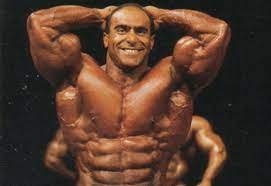
Nasser El Sonbaty was one of the most popular and successful bodybuilders of the 1990s. He was known for his massive physique, his impressive posing, and his nickname “The Professor”. He was also a highly educated and multilingual person who had a degree in history, political science, and sociology. He competed in many prestigious bodybuilding events, such as the Mr. Olympia, the Arnold Classic, and the Grand Prix. He was widely regarded as one of the best bodybuilders of his era and a potential Mr. Olympia winner. However, his career and life came to an abrupt and tragic end in 2013, when he died at the age of 47. What was the cause of his death? And what were the circumstances that led to his demise?
Contents
The Rise of Nasser El Sonbaty
Nasser El Sonbaty was born in Stuttgart, Germany, on October 15, 1965. His father was Egyptian and his mother was from Yugoslavia (now Serbia), the city of Novi Pazar. He grew up in Germany and began weight training at a young age. He quickly fell in love with bodybuilding and started competing in amateur competitions in his teenage years.
He earned his IFBB pro card in 1990 and made his pro debut at the Grand Prix Finland, where he placed eighth. He then competed in several other Grand Prix events that year, placing seventh in France and eighth in Holland. He also entered the Night of Champions, but did not place.
He continued to improve his physique and his placings in the following years, becoming a regular contender in the top shows. He won his first pro title at the Houston Pro Invitational in 1995, followed by another win at the Night of Champions that same year. He also placed third at the Mr. Olympia in 1995, behind Dorian Yates and Kevin Levrone.
He repeated his third-place finish at the Mr. Olympia in 1996, after winning four Grand Prix events that year. He also challenged Flex Wheeler for the Arnold Classic title, but had to settle for second place.
In 1997, he achieved his best result at the Mr. Olympia, placing second behind Dorian Yates. Many fans and experts believed that he deserved to win that year, as he displayed a more complete and balanced physique than Yates, who was suffering from injuries and had lost some size and symmetry. However, the judges favored Yates’ superior conditioning and hardness over El Sonbaty’s mass and aesthetics.
The Decline of Nasser El Sonbaty
After his controversial loss at the 1997 Mr. Olympia, El Sonbaty’s career began to decline. He never managed to recapture his peak form or challenge for the Olympia title again. He placed sixth at the Mr. Olympia in 1998, seventh in 1999, ninth in 2000, and fifteenth in 2002. He also competed in several other shows during this period, but did not win any of them.
He faced several problems that affected his performance and health, such as injuries, illnesses, drug abuse, and personal issues. He suffered from chronic back pain, which limited his training intensity and frequency. He also contracted hepatitis C from a contaminated needle, which damaged his liver function and immune system. He became addicted to painkillers and other drugs, which further worsened his condition.
He also had conflicts with the IFBB officials and judges, who he accused of being biased and corrupt. He claimed that he was unfairly marked down for being too big or too vascular or having synthol injections or gynecomastia surgery. He also criticized some of his fellow competitors for being dishonest or hypocritical about their drug use or their physiques.
He became more isolated and bitter as he felt that he was not given the recognition or respect that he deserved for his achievements and contributions to the sport. He expressed his frustration and anger in several interviews and articles that he wrote for various bodybuilding magazines and websites.
The Death of Nasser El Sonbaty
In March 2013, El Sonbaty traveled to Cairo, Egypt, to visit his family and friends. He also planned to undergo some medical tests and treatments for his health problems.
However, on March 20, 2013, he died in his sleep at a hotel room in Cairo. He was 47 years old.
The exact cause of his death was not officially confirmed or announced by his family or the authorities. However, according to some sources, he died from kidney failure due to complications from malaria, which he contracted during his stay in Egypt. Other sources suggested that he died from heart failure due to a combination of factors such as drug overdose, liver damage, high blood pressure, and obesity.
His death shocked and saddened the bodybuilding community and his fans around the world. He was remembered as one of the greatest bodybuilders of all time and a unique and charismatic personality. He was also mourned as a victim of a sport that pushed him to the edge and a system that failed to support him.
He was buried in Novi Pazar, Serbia, where his mother was from. He is survived by his two sisters and two brothers.
