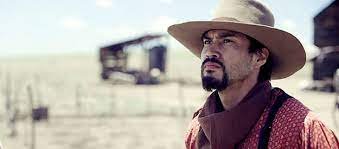
Montford Johnson was a prominent Chickasaw cattleman and entrepreneur who lived in Indian Territory, what is now the present-day state of Oklahoma. He was known for his successful ranching operation that spanned a large area of central Oklahoma, including parts of what would eventually become Oklahoma City. He also worked to improve the lives of fellow First Americans who had been forced onto reservations by the U.S. government, making agreements that allowed them to take cattle from his herds whenever they needed food. But how did this influential and respected man die? The answer is surprisingly simple and tragic: he died from a pimple.
A Difficult Childhood
Montford Johnson was born in November 1843, about two years after his older sister, Adelaide. His father, Charles “Boggy” Johnson, was an English Shakespearean actor who came to the United States with his brother when he was 19 years old and traveled in the South with a theater production. His mother, Rebekah Courtney Johnson, was half Chickasaw and half Scottish. After marrying, Rebekah and Charles migrated with the Chickasaws to Indian Territory during the Chickasaw Removal, a forced relocation of the tribe from their ancestral lands in Mississippi and Alabama to the west of the Mississippi River.
However, Montford’s mother became ill with pneumonia and died a few months after he was born. His father, distraught by his wife’s passing, decided to take the children and return east. As it was customary for Chickasaw families to take in motherless children and raise them as their own, his father’s Chickasaw in-laws insisted on raising the children. His father left without Adelaide and Montford, leaving them in the care of their grandmother, Sallie Tarntubby.
Montford grew up with his grandmother’s family, learning Chickasaw traditions and how to take care of livestock. He attended school at the Chickasaw Manual Labor Academy, where he learned farming techniques necessary to produce successful crop yields. He lived under the care of his grandmother until her death in 1858. At the end of that school year, he moved to the home of their next nearest relative, Sallie’s half-brother, U.S. Army Captain Townsend Hothliche, who was stationed at Fort Arbuckle, near present-day Davis, Oklahoma.
A Successful Cattleman
Montford Johnson’s life changed dramatically when he met and married Jennie McClure, a Choctaw woman, in 1861. They settled on a farm near Fort Arbuckle, where they raised cattle and horses. Montford also became involved in the Civil War, siding with the Confederacy and supplying beef and horses to the Confederate troops. He also participated in several battles and skirmishes, including the Battle of Honey Springs in 1863, where he was wounded in the leg.
After the war, Montford expanded his ranching business, acquiring more land and cattle. He also established a trading post and a stagecoach stop on his property, which became known as Silver City. He built a large two-story house for his family, which eventually included 11 children. He also hired several employees, both white and First American, to help him run his ranch. He became one of the wealthiest and most influential men in Indian Territory, earning the respect and friendship of many people, including U.S. Army officers, Indian agents, and tribal leaders.
A Tragic Death
Montford Johnson’s life came to an abrupt and unexpected end on February 17, 1896, when he died from erysipelas, a bacterial infection of the skin and underlying tissues. The illness started as a burning pimple on his lip, which he scratched and broke open. The infection spread through his body, causing fever, chills, and swelling. He was taken to his daughter’s home in Minco, Oklahoma, where he received medical attention from Dr. Hodges, who was fetched on horseback from across the flooded South Canadian River from Fort Reno, 25 miles away. However, it was too late to save him. He died at the age of 52, leaving behind a grieving family and a legacy of success and generosity.
Montford Johnson was buried in a private cemetery on his ranch, near his house. His grave was marked by a large sandstone slab, carved with his name and dates of birth and death. His wife, Jennie, died in 1902 and was buried next to him. Their graves were later joined by those of some of their children and grandchildren. The cemetery is still maintained by their descendants, who honor their memory and heritage.
Montford Johnson’s cause of death was a tragic example of how a seemingly minor and harmless condition can turn into a fatal one. His life, however, was a remarkable one, full of achievements and contributions to his community and his people. He was a proud Chickasaw, a successful cattleman, and a generous benefactor. He left a lasting impact on the history and culture of Oklahoma and the First American nations.
