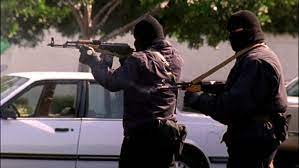
Larry Phillips Jr. was one of the two perpetrators of the infamous North Hollywood shootout, a violent and prolonged confrontation between two heavily armed bank robbers and the Los Angeles Police Department (LAPD) on February 28, 1997. The shootout resulted in the death of both robbers, as well as injuries to 12 police officers and eight civilians. But how did Larry Phillips Jr. die, and what led him to commit such a brazen crime?
Early Life and Criminal Career
Larry Phillips Jr. was born in Los Angeles, California on September 20, 1970, under the assumed name of Larry Warfel. His father, Larry Phillips Sr., was a fugitive who had escaped from a mental hospital in Colorado after being convicted of several crimes. Phillips Jr. witnessed his father’s arrest by federal agents when he was six years old, which may have influenced his later resentment of law enforcement.
Phillips Jr. grew up in a dysfunctional family and had a troubled childhood. He dropped out of high school and became involved in petty crimes, such as burglary, theft, and fraud. He also developed an interest in firearms and explosives, and amassed a large collection of weapons and ammunition.
In 1989, Phillips Jr. met Emil Mătăsăreanu, a Romanian immigrant who shared his fascination with guns and crime. The two became friends and partners in crime, and began planning more ambitious robberies. They targeted armored cars and banks, using sophisticated tactics and equipment to evade capture. They also modified their weapons to fire fully automatic, and wore body armor to protect themselves from bullets.
The North Hollywood Shootout
On February 28, 1997, Phillips Jr. and Mătăsăreanu attempted to rob the North Hollywood branch of Bank of America. They entered the bank at 9:17 a.m., armed with AK-47 rifles, handguns, and over 3,000 rounds of ammunition. They also wore homemade body armor that covered their entire bodies, except for their heads.
However, their robbery was foiled by an alert police officer who noticed their suspicious behavior and called for backup. As the robbers exited the bank with $303,305 in cash, they were confronted by dozens of police officers who had surrounded the building. A fierce gun battle ensued, lasting for 44 minutes.
The robbers fired indiscriminately at the police and civilians, while trying to escape in their getaway car. They also attempted to carjack several vehicles, but failed to do so. The police were outgunned and outmatched by the robbers’ firepower and armor, and had to resort to borrowing rifles from a nearby gun store.
The shootout ended when both robbers were fatally wounded by the police. Phillips Jr. was shot several times in the chest, arms, and legs, but his armor prevented him from bleeding out quickly. He retreated to a nearby residential street, where he continued to fire at the police until his rifle jammed. He then took out his handgun and shot himself in the head at 9:56 a.m., committing suicide.
Mătăsăreanu was shot 29 times in both legs by the police, causing severe blood loss. He crawled to a stolen truck that he had tried to drive away earlier, but was unable to start it due to its complex ignition system. He was surrounded by the police and left to bleed out on the pavement until he died at 10:01 a.m.
Legacy and Controversy
The North Hollywood shootout was one of the most violent and dramatic events in American history. It was broadcast live on television and radio, attracting millions of viewers and listeners. It also sparked a debate on gun control, police tactics, and media ethics.
The shootout exposed the inadequacy of the LAPD’s equipment and training in dealing with heavily armed criminals. As a result, the LAPD and other law enforcement agencies across the country upgraded their weapons, armor, and tactics to better handle such situations.
The shootout also raised questions about the media’s role in covering such events. Some critics argued that the live coverage of the shootout gave the robbers an advantage over the police, as they could monitor their movements and actions through radios or televisions. Others claimed that the media sensationalized the violence and glorified the criminals.
The shootout inspired several books, documentaries, movies, and video games that depicted or referenced the incident. Some examples are Heat (1995), 44 Minutes: The North Hollywood Shoot-Out (2003), Grand Theft Auto V (2013), and LA Cops (2015).
According to Criminal Minds Wiki, Larry Phillips Jr. and Emil Mătăsăreanu were also featured as real-life examples of bank robbers on an episode of Criminal Minds , a popular TV show about criminal profiling.
