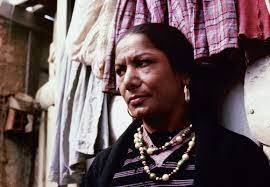
Carmen Amaya was a Spanish Romani flamenco dancer and singer, who was born in the Somorrostro district of Barcelona, Catalonia, Spain. She has been called “the greatest Flamenco dancer ever” and “the most extraordinary personality of all time in flamenco dance”. She was the first female flamenco dancer to master footwork previously reserved for the best male dancers, due to its speed and intensity. She sometimes danced in high-waisted trousers as a symbol of her strong character. She also performed in films, theaters, and festivals around the world, and was invited by President Franklin D. Roosevelt to dance at the White House in 1944. She died from a kidney disease in 1963, at the age of 50 or 48, depending on the source.
Contents
The Early Life of Carmen Amaya
Carmen Amaya was born to a Spanish Romani family, to José Amaya Amaya (aka “El Chino”, “The Chinaman”), a guitar player, and Micaela Amaya Moreno. Carmen was the second of eleven children, although only six (three sisters and two brothers) survived to adulthood. Her date of birth is disputed. Some sources name 1918 as her year of birth, citing Barcelona’s inhabitants list of 1930, in which a family Amalla with a 12-year-old daughter Carmen is mentioned. They claim that no birth document is available and the document of baptism was lost due to a church fire. Furthermore, a 1920 oil painting by Julio Moisés named Maternidad shows a mother with a 2-3 year old girl, supposed to be Carmen with her mother Micaela. According to them, photographs showing Carmen Amaya as a teenager also support 1918 as the year of birth. According to Montse Madridejos, professor of Music History at the University of Barcelona and a flamenco history researcher, who specializes in Carmen Amaya, her ethnicity could have also been a factor in the birth date ambiguity: “At that time, a gypsy was neither baptized, nor registered”. However José Luis Navarro García, cátedra de flamencología, as well as most other sources name 2 November 1913. This version is supported by the fact that in 1923 Carmen Amaya performed in a club in Madrid, which would be unlikely for a 5-year-old child, and a quote by Carmen Amaya herself in which she refers to her performance at the 1929 world exhibition: “… at the Barcelona exhibition in 1929, when I was sixteen years old … “. Her death certificate names 1 November 1915 as date of birth, however, perhaps splitting the difference.
Carmen Amaya entered the flamenco world accompanied by her father, an impoverished Calé Romani guitarist who made a living by playing in pubs day and night. She started dancing at a young age, and soon became known for her talent and charisma. She danced in taverns, cafés cantantes (flamenco venues), and music halls in Barcelona and Madrid. She also traveled with her family to France and Portugal, where she performed for aristocrats and celebrities. She was influenced by other flamenco artists such as Pastora Imperio, La Argentina, La Argentinita, Vicente Escudero, and Antonio de Bilbao.
The International Career of Carmen Amaya
In 1936, Carmen Amaya moved to Paris with her family to escape the Spanish Civil War. There she met the impresario Sol Hurok, who offered her a contract to perform in New York. She accepted and made her debut at Carnegie Hall in October 1941. She received rave reviews from critics and audiences alike, who praised her powerful and passionate style of dancing. She was dubbed “the human Vesuvius” by The New York Times. She also appeared on Broadway shows such as Follow the Girls and The Lady Has a Baby.
Carmen Amaya continued to tour extensively in North America and South America during the 1940s and 1950s. She performed in venues such as the Hollywood Bowl, the Metropolitan Opera House, the Copacabana Club, and the Colón Theater. She also starred in several films such as Knickerbocker Holiday (1944), Los Tarantos (1963), Maria de la O (1936), El Embrujo del Fandango (1949), and Zorro’s Black Whip (1944). She collaborated with other famous artists such as Sabicas, Mario Escudero, José Greco, Agustín Castellón Campos (aka Sabicas), Xavier Cugat, Charles Chaplin, Orson Welles, and Marlon Brando.
Carmen Amaya also visited her homeland several times after the end of the civil war. She performed in festivals such as the Bienal de Flamenco de Sevilla, the Festival Internacional de Música y Danza de Granada, and the Festival de Cante Jondo de Córdoba. She also received honors and awards such as the Lazo de Dama de Isabel la Católica, the Medalla de Oro al Mérito en el Trabajo, and the Premio Nacional de Flamenco.
The Death of Carmen Amaya
Carmen Amaya suffered from a kidney disease that worsened over time. She ignored the advice of her doctors and continued to dance until the end of her life. She died in Begur, Girona, northeast Catalonia, in 1963 and is buried at the Cemetery of Ciriego in Santander. She was mourned by millions of fans and admirers around the world, who recognized her as a flamenco legend and a cultural icon. Her legacy lives on in the generations of flamenco dancers who have followed her footsteps, such as Antonio Gades, Cristina Hoyos, Sara Baras, Joaquín Cortés, and Rocío Molina. She also inspired other artists from different fields such as Pablo Picasso, Salvador Dalí, Federico García Lorca, Ernest Hemingway, and Jean Cocteau.
Conclusion
Carmen Amaya was a flamenco dancer and singer who revolutionized the art form with her unique and innovative style. She was born in Barcelona to a Romani family and started dancing at a young age. She traveled the world and performed in prestigious venues and festivals. She also appeared in films and collaborated with other renowned artists. She died from a kidney disease in 1963, leaving behind a legacy of flamenco excellence and influence. She is widely regarded as one of the greatest flamenco dancers of all time and one of the most important figures in Spanish culture.
