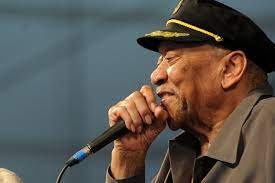
Bobby Bland, also known as Bobby “Blue” Bland, was one of the most influential blues and soul singers of all time. He had a distinctive voice that blended gospel, blues and R&B, and he recorded dozens of hit songs such as “Further On Up the Road”, “Turn On Your Love Light” and “Ain’t No Love in the Heart of the City”. He was inducted into the Rock and Roll Hall of Fame in 1992 and received the Grammy Lifetime Achievement Award in 1997. He died on June 23, 2013 at the age of 83. What was the cause of his death and how did he spend his final days? Here is a brief overview of his life and legacy.
Early Life and Career
Bobby Bland was born Robert Calvin Brooks on January 27, 1930 in Barretville, Tennessee. His father abandoned the family when he was a baby, and he later took the surname of his stepfather, Leroy Bland. He dropped out of school in third grade and moved to Memphis with his mother in 1947. There, he started singing with local gospel groups and became friends with other aspiring musicians such as B.B. King, Rosco Gordon and Johnny Ace. They formed a group called the Beale Streeters, named after the famous street where they performed.
In 1951, Bland recorded his first songs for Modern Records with the help of Ike Turner, who played piano for him. However, his career was interrupted by his military service in the U.S. Army from 1952 to 1954. After he returned to Memphis, he signed with Duke Records and began to develop his own style of singing, influenced by Nat King Cole, Perry Como and Frank Sinatra. He also adopted a trademark technique of snorting or growling between phrases, which added emotion and intensity to his vocals.
Success and Fame
Bland’s first hit came in 1957 with “Farther Up the Road”, which reached number one on the R&B chart and number 43 on the pop chart. He followed it with a string of successful singles such as “Little Boy Blue”, “I Pity the Fool”, “That’s the Way Love Is” and “Don’t Cry No More”. He also collaborated with his friend B.B. King on several albums and tours, earning them the nickname “the Sinatra of the blues” and “the King of the blues” respectively.
Bland’s popularity peaked in the mid-1960s, when he released some of his most acclaimed albums such as Two Steps from the Blues, Here’s the Man!!! and The Soul of the Man. He also crossed over to the pop audience with songs like “Turn On Your Love Light”, “Ain’t Nothing You Can Do” and “Ain’t No Love in the Heart of the City”. His music influenced many rock artists such as Eric Clapton, Van Morrison, David Bowie and Led Zeppelin.
Later Years and Death
Bland continued to record and perform throughout the 1970s and 1980s, but his commercial success declined as musical tastes changed. He switched labels several times and experimented with different genres such as disco, funk and country. He also faced personal problems such as alcoholism, drug addiction and financial troubles. However, he never lost his loyal fan base and received recognition from critics and peers for his contributions to music.
In 1992, he was inducted into the Rock and Roll Hall of Fame by B.B. King, who praised him as “one of my best friends” and “one of my favorite singers”. In 1997, he received the Grammy Lifetime Achievement Award for his “outstanding artistic significance to the field of recording”. In 2012, he was honored by the Memphis Music Hall of Fame for being “one of Memphis’ most beloved musical icons”.
Bland’s health deteriorated in his later years due to diabetes, hypertension and chronic obstructive pulmonary disease. He died on June 23, 2013 at his home in Germantown, Tennessee from complications of an ongoing illness. According to his son Rodd Bland, who was also his drummer, he passed away peacefully in his arms. He was survived by his wife Willie Martin Bland, whom he married in 1969, four sons and two daughters.
Bobby Bland’s legacy lives on through his music, which has been covered by countless artists across genres and generations. He is widely regarded as one of the greatest blues singers of all time and one of the pioneers of soul music. His voice has been described as “among the great storytellers of blues and soul music… [who] created tempestuous arias of love, betrayal and resignation, set against roiling, dramatic orchestrations, and left the listener drained but awed” (according to Wikipedia). He was truly a legend and an inspiration to many.
