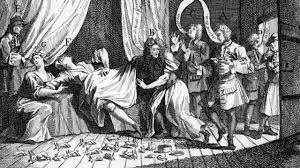
Mary Toft was an English woman who became the subject of a bizarre medical hoax in 1726. She claimed to have given birth to several rabbits, and convinced many prominent physicians and even the king’s surgeon of her extraordinary condition. However, she was eventually exposed as a fraud and imprisoned for her deception. But what was the cause of her death, and what motivated her to carry out such a strange and elaborate scheme?
The Rabbit Hoax
Mary Toft was born in 1701 in Godalming, Surrey, a poor rural area. She married a textile worker named Joshua Toft at the age of 17, and had two children. In 1726, she became pregnant again, but miscarried in August. She later said that she had passed an object “as big as [her arm]” and then experienced a “flooding” that lasted about a week. This may have been the result of an abnormality of the developing placenta, which would have caused the embryo to stop developing and blood clots and flesh to be ejected.
In September, she claimed to have given birth to several pieces of animal flesh, including a cat’s paw, a hog’s bladder, and a rabbit’s head. She said that she had developed a craving for rabbits after seeing one in a field while working, and that she could not stop thinking about them. She attracted the attention of John Howard, a local surgeon and midwife, who examined her and delivered more animal parts from her womb. He was astonished by her case, and wrote to several prominent physicians in London, including Nathaniel St. André, the surgeon to King George I.
St. André visited Toft in November, and witnessed her giving birth to more rabbits. He was convinced that she was telling the truth, and wrote a pamphlet describing her case as a medical marvel. He also brought her to London, where she was examined by more doctors and curious spectators. Among them was Cyriacus Ahlers, another surgeon to the king, who was skeptical of Toft’s story. He noticed that the rabbits she produced were not wild, but domesticated, and that they had been cut with a knife. He also found traces of hay and corn in their mouths, suggesting that they had been fed before being inserted into Toft’s body.
The Confession and the Consequences
Ahlers confronted Toft with his findings, and threatened to perform a painful operation on her if she did not confess. Toft finally admitted that she had been part of a hoax, and that she had been helped by her mother-in-law and a friend, who had supplied her with dead rabbits and other animals. They had inserted the animal parts into her vagina, and then pretended to deliver them. Toft said that she had done it for money, and that she had been promised a pension by a mysterious woman who had visited her in Godalming.
Toft was arrested and taken to Bridewell Prison, where she was interrogated by a panel of experts. She repeated her confession, and named several accomplices, including Howard, the local surgeon, who had been paid to spread the news of her case. She also said that she had suffered a seizure, during which she lost consciousness, and that she had a severe fever and infection as a result of the hoax. Some of the doctors who had examined her also admitted that they had been deceived, and apologized for their error. However, others, like St. André, refused to accept that Toft had lied, and continued to defend her case as genuine.
The public reaction to Toft’s exposure was a mix of ridicule and outrage. The case became a source of mockery and satire, especially among the political opponents of the king, who saw it as a symbol of the corruption and incompetence of his regime. The case also damaged the reputation and credibility of the medical profession, which had been duped by a poor and illiterate woman. The case also raised questions about the nature and limits of human reproduction, and the role of imagination and emotion in pregnancy.
The Death of Mary Toft
Toft was eventually released from prison in April 1727, without being charged or punished. She returned to Godalming, where she lived in obscurity and poverty. She had two more children, both of whom died in infancy. She died in 1763, at the age of 62, of unknown causes. She was buried in an unmarked grave in Godalming churchyard.
Mary Toft’s case remains one of the most bizarre and fascinating episodes in the history of medicine and human psychology. It shows how easily people can be deceived by their own expectations and beliefs, and how difficult it can be to distinguish between truth and falsehood. It also reveals the vulnerability and desperation of a woman who resorted to a desperate and dangerous scheme to escape her miserable condition. Mary Toft’s cause of death may never be known, but her life and legacy are still worth remembering.
