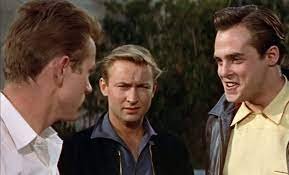
Nick Adams was a young actor who rose to fame in the 1950s and 1960s, starring in films like Rebel Without a Cause, Giant, and Frankenstein Conquers the World. He was also known for his friendships with James Dean and Elvis Presley, two of the biggest icons of his era. But behind his success and popularity, there was a dark side to his life that led to his untimely death at the age of 36. What was the cause of Nick Adams’s death? And what were the circumstances that surrounded it? Here is a brief overview of his life and death, based on the information available online.
Early Life and Career
Nick Adams was born as Nicholas Aloysius Adamshock in Nanticoke, Pennsylvania, on July 10, 1931. He was the son of Ukrainian immigrants who worked as coal miners. He grew up in poverty and witnessed the death of his uncle in a mining accident when he was five years old. According to Wikipedia, he later recalled that the company doctor who examined his uncle told his father, “You’ve got two fine boys, they’ll make good miners.” This remark sparked Nick’s ambition to escape his bleak environment and pursue a different career.
Nick was interested in acting from an early age and participated in school plays. He also excelled in sports and became a champion boxer in high school. He graduated in 1949 and moved to New York City to pursue acting. He worked as a gas station attendant, a waiter, and a messenger while auditioning for roles. He also changed his name to Nick Adams to sound more American.
In 1951, he hitchhiked to Los Angeles with only $200 in his pocket. He lived in a cheap hotel and took odd jobs while looking for opportunities in Hollywood. He managed to get some small parts in films and TV shows, often playing juvenile delinquents or soldiers. He also befriended other aspiring actors like James Dean, Dennis Hopper, and Robert Conrad.
Breakthrough and Stardom
Nick’s big break came in 1955 when he was cast as one of the gang members in Rebel Without a Cause, starring James Dean. The film was a huge hit and made Nick a recognizable face among the young audience. He also became close friends with Dean, who shared his passion for acting and racing cars. Nick was devastated when Dean died in a car crash later that year.
Nick continued to work steadily in Hollywood, appearing in films like Giant (1956), No Time for Sergeants (1958), Pillow Talk (1959), and The Last Wagon (1956). He also starred in his own TV series, The Rebel (1959-1961), playing Johnny Yuma, a Confederate soldier turned wandering journalist after the Civil War. The show was popular and earned Nick an Emmy nomination for best actor.
Nick also married actress Carol Nugent in 1959 and had two children with her: Allyson Lee (born 1960) and Jeb Stuart (born 1961). However, their marriage was troubled by Nick’s infidelity, insecurity, and drug abuse. They separated in 1965 and divorced in 1967.
Decline and Death
In the early 1960s, Nick’s career began to decline as he struggled to find good roles in Hollywood. He also faced financial difficulties and legal troubles due to his involvement in a car accident that killed a woman in 1962. He was cleared of any wrongdoing, but the incident damaged his reputation.
Nick tried to revive his career by working overseas, especially in Japan. He starred in several Japanese sci-fi films, such as Frankenstein Conquers the World (1965), Invasion of Astro-Monster (1965), and The Killing Bottle (1967). He also wrote some scripts for these films under the pseudonym Leslie P. Davies.
Nick also maintained his friendship with Elvis Presley, whom he met on the set of Love Me Tender (1956). He often visited Presley at his home or on tour, acting as his confidant and companion. Presley reportedly offered Nick a role in his upcoming film Change of Habit (1969), but Nick never got the chance to accept it.
On February 7, 1968, Nick Adams was found dead in his home in Beverly Hills by his lawyer Ervin “Tip” Roeder. According to Crime Magazine, Roeder had gone to check on Nick after not hearing from him for several days. He found Nick’s body sitting beside his bed, fully clothed and clutching a telephone receiver.
The cause of Nick’s death was initially unclear, as there were no signs of violence or suicide. However, an autopsy revealed that he had died of a drug overdose. According to The Movie Database, he had taken a lethal combination of paraldehyde, a sedative, and promazine, an antipsychotic. Both drugs had been prescribed to him by his brother, Dr. Andrew Adams, who was a psychiatrist.
The coroner ruled Nick’s death as an accidental suicide, meaning that he did not intend to kill himself but was careless with his medication. However, some people speculated that Nick’s death was not accidental, but rather a murder or a cover-up. Some of the theories suggested that Nick was killed by the Mafia, by his ex-wife, by his brother, or by someone who wanted to silence him about his knowledge of James Dean’s death.
None of these theories have been proven, and Nick’s death remains a mystery to this day. What is certain is that Nick Adams died too young and too soon, leaving behind a legacy of films and TV shows that showcase his talent and charisma. He also left behind a family and friends who loved him and mourned him. He was buried at the Berwick Cemetery in Berwick, Pennsylvania, near his hometown of Nanticoke. His epitaph reads: “Nick Adams / Star of Screen and TV / The Rebel.”
