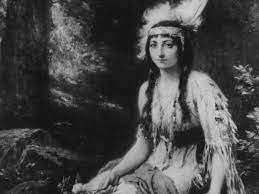
Pocahontas is one of the most famous figures in American history, but her real story is very different from the popular image. She was a Native American woman who played a vital role in the early interactions between the English colonists and the Powhatan people in Virginia. She was also the first Native American to visit England and be presented to the royal court. But how did she die, and what was the cause of her death?
Contents
Pocahontas’s Early Life and Encounter with John Smith
Pocahontas was born around 1596, the daughter of Powhatan, the paramount chief of a network of tributary tribes in the Tidewater region of Virginia. Her real name was Matoaka, but she was also known by her nickname Pocahontas, which means “playful one” or “little wanton”
She first met John Smith, an English explorer and leader of the Jamestown colony, in 1607, when he was captured by the Powhatans and brought before her father. According to Smith’s account, Pocahontas saved his life by putting her head on his when he was about to be executed. However, some historians doubt the accuracy of this story and suggest that it was part of a ritual to adopt Smith as a subordinate chief
After this episode, Pocahontas began visiting Jamestown regularly, bringing food and gifts to the colonists and serving as a mediator between them and her people. She also befriended a young English boy named Thomas Savage, who was given to Powhatan as a hostage in exchange for another Powhatan named Namontack. Pocahontas helped Thomas learn the Powhatan language and culture
Pocahontas’s Captivity and Conversion to Christianity
In 1613, during a period of hostilities between the English and the Powhatans, Pocahontas was kidnapped by Captain Samuel Argall, who demanded a ransom from Powhatan for her release. She was taken to Jamestown and then to Henricus, where she was held for about a year. During her captivity, she was taught English and instructed in Christianity by Reverend Alexander Whitaker. She also met John Rolfe, a tobacco planter who fell in love with he
Pocahontas agreed to marry Rolfe on the condition that he would not harm her people. She also consented to be baptized under the name Rebecca. The marriage took place in April 1614, and it resulted in a temporary peace between the English and the Powhatans. In January 1615, Pocahontas gave birth to a son named Thomas Rolfe.
Pocahontas’s Journey to England and Death
In 1616, Rolfe decided to take his wife and son to England, where they were received with curiosity and admiration by the English society. Pocahontas was presented as an example of a “civilized savage” and a symbol of the potential for harmony between the two cultures. She met King James I and Queen Anne at Whitehall Palace, and attended a masque at the Banqueting House. She may have also met Squanto, a Patuxet man from New England who had been kidnapped by English explorers and later returned to his homeland.
However, Pocahontas’s health began to decline in England. She suffered from respiratory problems, possibly caused by the pollution and climate of London. In March 1617, as she and her family were preparing to sail back to Virginia, she fell ill on board the ship. She died at Gravesend, Kent, England, of unknown causes, aged 20 or 21. She was buried at St George’s Church, Gravesend; her grave’s exact location is unknown because the church was rebuilt after being destroyed by a fire.
Pocahontas’s Legacy and Controversy
Pocahontas’s story has been romanticized and fictionalized over the years, especially by Disney’s 1995 animated film Pocahontas, which portrayed her as an adult woman who had a romantic relationship with John Smith. Many aspects of this version are inaccurate or disputed by historical evidence and by her documented descendants.
Pocahontas is still remembered as a remarkable woman who bridged two worlds and cultures. She is a subject of art, literature, and film. Many famous people have claimed to be among her descendants, including members of the First Families of Virginia, First Lady Edith Wilson, American actor Glenn Strange, and astronomer Percival Lowell.
She is also honored by several monuments and places named after her, such as the Pocahontas State Park in Virginia, the Pocahontas County in West Virginia, and the Pocahontas Island in Petersburg, Virginia. She is one of the few women to have a statue in the U.S. Capitol.
Pocahontas’s cause of death remains a mystery, but her life and legacy are undeniable. She was a brave, intelligent, and compassionate woman who made a lasting impact on American history.
