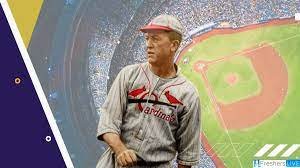
Grover Cleveland Alexander, also known as Old Pete, was one of the greatest pitchers in the history of baseball. He played for the Philadelphia Phillies, the Chicago Cubs, and the St. Louis Cardinals from 1911 to 1930, winning 373 games and three Triple Crowns. He was inducted into the Baseball Hall of Fame in 1938. However, his life was not without struggles and hardships. He suffered from epilepsy, alcoholism, and depression, which affected his performance and personal relationships. He died alone and almost penniless in 1950, at the age of 63, from heart failure. His death was a sad end to a brilliant career that inspired many generations of baseball fans.
Contents
Early Life and Career
Alexander was born in Elba, Nebraska, on February 26, 1887. He was one of eight children born to William Alexander and Martha Cootey. His father was a Democrat, and he was named after President Grover Cleveland, who was in office at the time. He attended the schools of Elba and St. Paul, and graduated from St. Paul High School in 1909. After completing his education, he worked as a posthole digger for the Howard County Telephone Company.
Alexander played semi-professional baseball in his youth, signing his first professional contract at age 20 in 1907 for $50 per month. In 1909, he played for the Galesburg Boosters in the Class D Illinois–Missouri League and went 15–8 that year with a 1.36 ERA. His career was almost ended when he was struck by a thrown ball while baserunning, which caused him to suffer from double vision. However, he recovered by 1910 and became a star pitcher again, finishing with a 29–11 record for the Syracuse Stars in the Class B New York State League. He was then sold to the Philadelphia Phillies for $750.
He made his major league debut on April 15, 1911, and quickly established himself as one of the best pitchers in the league. He led the league with 28 wins (a modern-day rookie record), 31 complete games, 367 innings pitched, and seven shutouts in his first season. He also formed a strong partnership with catcher Bill Killefer, who caught 250 of his games. He won six National League strikeout titles, four ERA titles, and three Triple Crowns (leading the league in wins, strikeouts, and ERA) in his career. He also pitched four no-hitters and set a record for most shutouts in a season with 16 in 1916.
World War I and Aftermath
In 1917, Alexander was traded to the Chicago Cubs for $55,000 and two players. He continued to dominate the league with his pitching skills, winning 22 games and posting a 1.73 ERA in his first season with the Cubs. However, his career was interrupted by World War I, which he joined in 1918 as a sergeant in the U.S. Army’s artillery division. He saw combat in France and was exposed to mustard gas and shell shock. He also developed epilepsy as a result of his war injuries.
After returning from the war, Alexander resumed his baseball career with the Cubs, but he was not the same pitcher as before. He struggled with his health problems and became dependent on alcohol to cope with his pain and seizures. He also had marital troubles with his wife Amy Marie Arrants, whom he married in 1918 before leaving for war. They divorced in 1929 after several separations and reconciliations.
Despite his personal issues, Alexander still managed to pitch at a high level for most of the 1920s. He won his third Triple Crown in 1920 with 27 wins, a 1.91 ERA, and 173 strikeouts. He also helped the Cubs win four consecutive National League pennants from 1923 to 1926.
The Miracle of St. Louis
In June of 1926, Alexander was traded to the St. Louis Cardinals for $10,000 and two players. The Cardinals were in a tight pennant race with the Cincinnati Reds and needed a veteran pitcher to boost their rotation. Alexander proved to be a valuable addition to the team, winning nine games and posting a 2.91 ERA in the second half of the season.
The Cardinals won the National League pennant by two games over the Reds and faced the New York Yankees in the World Series. The Yankees were led by Babe Ruth and Lou Gehrig, who combined for 74 home runs and 262 RBIs that season.
Alexander started Game Two of the World Series and pitched a complete game victory over the Yankees, allowing only one run on six hits while striking out six batters.
He then started Game Six and pitched another complete game win, shutting out the Yankees on three hits while striking out 10 batters.
The series went to a decisive Game Seven, which the Cardinals led 3–2 in the bottom of the seventh inning. However, the Yankees had two runners on base and two outs, and Ruth was coming to bat. Cardinals manager Rogers Hornsby decided to bring in Alexander from the bullpen, even though he had pitched nine innings the day before.
Alexander faced Tony Lazzeri, who had 18 home runs and 102 RBIs that season. Alexander quickly got two strikes on Lazzeri, but then threw a ball. On the next pitch, Lazzeri hit a high fly ball to left field that looked like it might be a grand slam. However, the ball fell short of the fence and was caught by left fielder Chick Hafey for the third out.
Alexander then retired the Yankees in order in the eighth and ninth innings, securing the Cardinals’ first World Series title. He struck out Ruth for the final out, as Ruth tried to steal second base after drawing a walk.
Alexander’s performance in the 1926 World Series was one of the most remarkable feats in baseball history. He pitched 21 innings in three games, allowing only three runs on 13 hits while striking out 26 batters. He also became the first pitcher to win two games and save another in a single World Series.
Final Years and Death
Alexander played three more seasons with the Cardinals, winning 21 games in 1927 and 16 games in 1928. He also helped the Cardinals win another National League pennant in 1928, but they lost to the Yankees in a four-game sweep in the World Series.
In 1930, Alexander returned to the Phillies for his final season. He won only three games and posted a 9.14 ERA in 14 appearances. He retired at the end of the season with a career record of 373–208 and a 2.56 ERA. He ranks third on the all-time wins list behind Cy Young and Walter Johnson.
After his retirement, Alexander worked as a coach for various minor league teams and as a scout for the Phillies. He also made occasional appearances at old-timers’ games and baseball events. However, he continued to struggle with his health and financial problems. He was diagnosed with cancer and heart disease in his later years. He also lost most of his savings due to bad investments and gambling debts.
On November 4, 1950, Alexander was found dead of heart failure in a small room he rented from Mrs. Josie Nevrivy in St. Paul, Nebraska. He died alone, almost destitute, and in poor health. He was buried at Elmwood Cemetery in St. Paul.
His death was mourned by many baseball fans and players who admired his courage and skill on the mound. He was remembered as one of the greatest pitchers of all time and a hero of the 1926 World Series.
According to Wikipedia, he was portrayed by Ronald Reagan in the 1952 biographical film The Winning Team, which focused on his relationship with his wife Amy and his comeback with the Cardinals.
He was also honored by having his number 26 retired by the Phillies and being inducted into their Wall of Fame. He was also elected into the Chicago Cubs Hall of Fame.
Grover Cleveland Alexander’s cause of death was a tragic end to a legendary career that inspired many generations of baseball fans. His legacy lives on as one of the finest right-handed pitchers of all time and a symbol of perseverance and determination.
