Have you ever wondered what temperature and thermal energy are, and how they are connected? If so, you are not alone. Many people confuse these two concepts, or think that they are the same thing. However, temperature and thermal energy are different, and understanding their relationship can help you learn more about the physics of heat and energy.
Contents
What is Temperature?
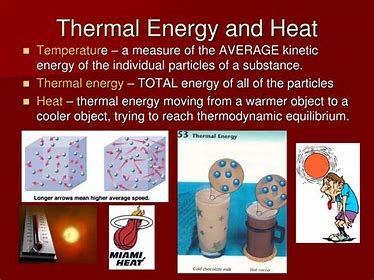
Temperature is a measure of how hot or cold something is. It is related to the average kinetic energy of the particles (atoms or molecules) in a substance. Kinetic energy is the energy of motion, and it depends on the speed and mass of the particles. The faster the particles move, the more kinetic energy they have, and the higher the temperature of the substance.
Temperature can be measured using a thermometer or other temperature-sensing device. There are different scales for measuring temperature, such as Celsius, Fahrenheit, and Kelvin. The Celsius scale is based on the freezing point (0 °C) and boiling point (100 °C) of water at sea level. The Fahrenheit scale is based on the freezing point (32 °F) and boiling point (212 °F) of water at sea level. The Kelvin scale is based on absolute zero (-273.15 °C or -459.67 °F), which is the lowest possible temperature where all particles stop moving.
What is Thermal Energy?
Thermal energy is the total energy of all particles in a substance. It is related to temperature, mass, composition, and external forces. Thermal energy includes both kinetic energy and potential energy of the particles. Potential energy is the energy stored in the bonds between particles, or in the position of particles in a gravitational or electric field.
Thermal energy can be transferred from one substance to another by heat. Heat is the flow of thermal energy due to a temperature difference. Heat can be transferred by three methods: conduction, convection, and radiation. Conduction is the transfer of heat by direct contact between particles. Convection is the transfer of heat by the movement of fluids (liquids or gases). Radiation is the transfer of heat by electromagnetic waves.
Thermal energy can also be converted into other forms of energy, such as mechanical, electrical, or chemical energy. For example, when you burn a candle, thermal energy is released by breaking the chemical bonds in the wax and oxygen molecules. This thermal energy can then be used to heat up a room, or to produce light.
How are Temperature and Thermal Energy Related?
Temperature and thermal energy are related, but not proportional. This means that two substances with the same temperature may have different amounts of thermal energy, depending on their mass and composition. For example, a cup of hot water and a bathtub of hot water may have the same temperature, but the bathtub has more thermal energy because it has more water molecules.
Similarly, two substances with different temperatures may have the same amount of thermal energy, depending on their mass and composition. For example, a cup of ice and a cup of water may have the same thermal energy, but different temperatures. The ice has a lower temperature because its particles move slower than water particles. However, ice has more potential energy than water because its particles are more tightly bonded together.
The relationship between temperature and thermal energy can be expressed by this formula:
��=���ET=mcT
where ��ET is thermal energy, �m is mass, �c is specific heat capacity (a property that depends on the composition of the substance), and �T is temperature.
This formula shows that thermal energy depends on three factors: mass, specific heat capacity, and temperature. If any of these factors changes, so does thermal energy.
Conclusion
Temperature and thermal energy are two important concepts in physics that describe how hot or cold something is, and how much energy it contains. Temperature measures the average kinetic energy of particles in a substance, while thermal energy measures the total energy of all particles in a substance. Temperature and thermal energy are related, but not proportional. They depend on factors such as mass, composition, and external forces.
Understanding how temperature and thermal energy are related can help you explain various phenomena in nature and everyday life, such as why metals feel colder than wood, why water boils faster at higher altitudes, or why we sweat when we exercise.
According to Khan Academy, “thermal energy refers to the energy contained within a system that is responsible for its temperature”. According to OpenStax, “temperature measures how hot or cold an object is”. According to Ask Any Difference, “the average kinetic energy within an object is called thermal energy”. According to Toppr, “the hotter the substance, the more will be its thermal energy”.
