A database is a system that stores and organizes data in a way that allows easy access and manipulation by a computer program. A database can contain various types of data, such as text, numbers, images, audio, video, etc. A database can also have different levels of structure, depending on how the data is arranged and related to each other. One of the most common and widely used types of database is the relational database, which is based on the concept of tables.
What is a Table in a Database?
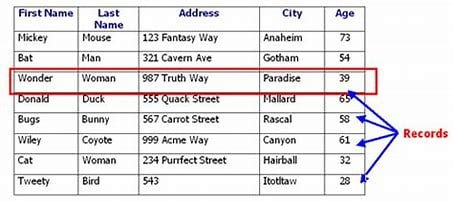
A table in a database is a collection of related records that share the same structure and attributes. A record is a single unit of data that consists of one or more fields. A field is a specific piece of data that represents an aspect or property of the record. For example, a table that stores information about employees can have records that contain fields such as employee ID, name, position, department, salary, etc. Each record in the table represents an individual employee, and each field in the record represents a characteristic of the employee.
A table can have any number of records and fields, depending on the data requirements and design of the database. However, a table must have at least one field that uniquely identifies each record in the table. This field is called the primary key, and it ensures that no two records in the table have the same value for that field. For example, in the employee table, the employee ID can be used as the primary key, since no two employees can have the same ID.
A table can also have relationships with other tables in the database, based on the values of certain fields. These fields are called foreign keys, and they refer to the primary keys of other tables. For example, in the employee table, the department field can be a foreign key that refers to the primary key of another table that stores information about departments. This way, the database can link data from different tables and create meaningful associations between them.
Why are Tables Important in a Database?
Tables are important in a database because they provide a logical and efficient way to store and retrieve data. Tables allow data to be organized into categories and subcategories that reflect the nature and purpose of the data. Tables also enable data to be structured and formatted according to predefined rules and standards that ensure consistency and accuracy. Tables also facilitate data processing operations such as searching, sorting, filtering, grouping, aggregating, calculating, etc., by using queries that specify the criteria and conditions for selecting and manipulating data from one or more tables.
Tables are also essential for maintaining data integrity and security in a database. Data integrity refers to the quality and reliability of data, which means that data should be complete, accurate, consistent, and valid. Data security refers to the protection of data from unauthorized access, modification, deletion, or disclosure. Tables help to achieve data integrity and security by enforcing constraints and rules that define how data can be entered, updated, deleted, or accessed in the database. Tables also support transactions and backups that ensure that data is always available and recoverable in case of errors or failures.
Conclusion
A collection of related records in a database is referred to as a table. A table is a fundamental component of a relational database that stores and organizes data in rows (records) and columns (fields). A table has a primary key that uniquely identifies each record in the table, and can have foreign keys that relate to other tables in the database. Tables provide a logical and efficient way to store and retrieve data, as well as maintain data integrity and security. Tables are used to perform various data processing operations using queries that manipulate data from one or more tables.
