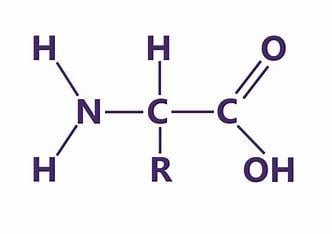
Proteins are essential molecules for life, performing a variety of functions in living organisms. Proteins are made of smaller units called amino acids, which are linked together by peptide bonds to form long chains called polypeptides. The sequence of amino acids in a polypeptide chain determines the primary structure of a protein, which is the simplest level of protein structure.
However, proteins are not just linear chains of amino acids. They also have higher levels of organization, such as secondary, tertiary and quaternary structures, which depend on the interactions between different parts of the polypeptide chain or between different polypeptide chains. These interactions are influenced by the chemical properties of the amino acids, such as their polarity, charge, size and shape.
In this article, we will explore some of the questions related to protein structure, such as:
- Which of the following is directly related to a single amino acid?
- How do amino acids interact to form secondary structures?
- What are some examples of proteins with different levels of structure?
- How can a single amino acid change affect the function of a protein?
Contents
One question that may arise when studying protein structure is which of the following is directly related to a single amino acid:
- The base sequence of the tRNA
- The amino acetyl tRNA synthase
- The three-base sequence of mRNA
- The complementarity of DNA and RNA
The answer is the three-base sequence of mRNA.
mRNA stands for messenger RNA, which is a type of RNA molecule that carries the genetic information from DNA to the ribosome, where proteins are synthesized. The process of making mRNA from DNA is called transcription, and it involves an enzyme called RNA polymerase that reads the DNA template strand and makes a complementary RNA strand.
The mRNA molecule consists of a series of three-base sequences called codons, each of which corresponds to a specific amino acid. For example, the codon AUG codes for the amino acid methionine, while the codon UUU codes for the amino acid phenylalanine. There are 64 possible codons in the genetic code, but only 20 different amino acids, so some codons code for the same amino acid. This is called redundancy or degeneracy of the genetic code.
The three-base sequence of mRNA is directly related to a single amino acid because it determines which amino acid will be added to the growing polypeptide chain during translation, which is the process of making proteins from mRNA. Translation involves another type of RNA molecule called tRNA, which stands for transfer RNA. tRNA molecules have two important features: an anticodon and an amino acid attachment site. The anticodon is a three-base sequence that is complementary to a specific codon on the mRNA. For example, if the mRNA has a codon AUG, then the tRNA that binds to it will have an anticodon UAC. The amino acid attachment site is where a specific amino acid is attached to the tRNA by an enzyme called aminoacyl tRNA synthetase. For example, if the tRNA has an anticodon UAC, then it will have a methionine attached to it.
During translation, the ribosome moves along the mRNA and matches each codon with its corresponding tRNA. The amino acid carried by the tRNA is then transferred to the growing polypeptide chain by forming a peptide bond with the previous amino acid. This way, the sequence of codons on the mRNA determines the sequence of amino acids on the polypeptide chain.
Therefore, we can say that the three-base sequence of mRNA is directly related to a single amino acid because it specifies which amino acid will be incorporated into the protein.
How do amino acids interact to form secondary structures?
Another question that may arise when studying protein structure is how do amino acids interact to form secondary structures.
Secondary structure refers to the local folding or coiling of parts of the polypeptide chain due to hydrogen bonding between atoms in the backbone. The backbone consists of repeating units of N-C-C (nitrogen-carbon-carbon) atoms that link each amino acid together. The hydrogen bonds form between the oxygen atom (O) in one peptide bond and
