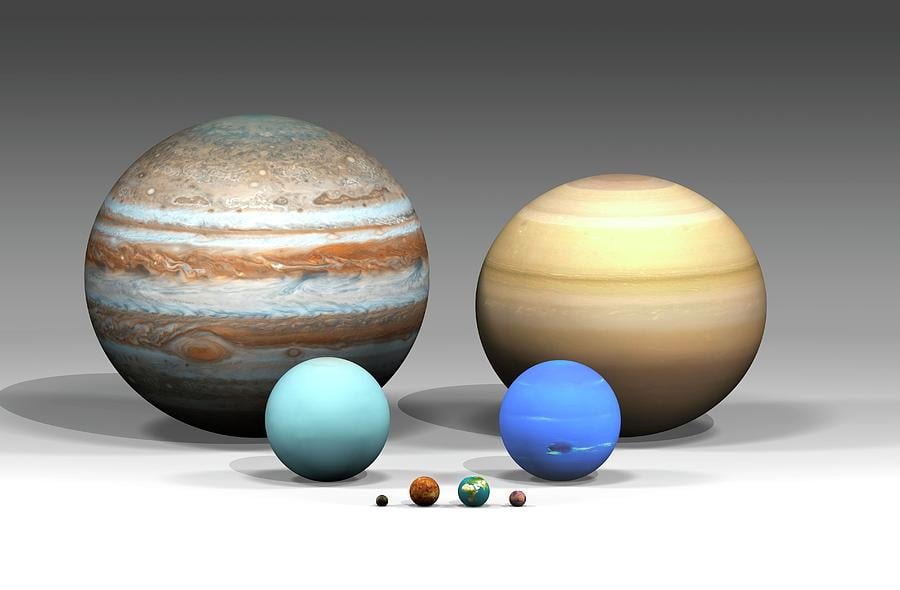
Have you ever wondered why some planets have thick atmospheres while others have thin or no atmospheres at all? How does the size of a planet affect the amount of gas it can retain in its atmosphere? What are the implications of having a thick or thin atmosphere for life and climate? In this article, we will explore these questions and more, using examples from our own solar system and beyond.
Contents
The Role of Gravity and Temperature
The thickness of a planet’s atmosphere depends on two main factors: the planet’s gravity and the temperature of the atmosphere. A planet with weaker gravity does not have as strong a hold on the molecules that make up its atmosphere as a planet with stronger gravity. The gas molecules will be more likely to escape the planet’s gravity, especially if they are moving fast due to high temperature. This is why smaller planets tend to have thinner atmospheres than larger planets, all else being equal.
According to Toppr, the temperature of the atmosphere also affects its thickness, because it determines how fast the gas molecules are moving. The higher the temperature, the faster the molecules move, and the more likely they are to overcome the planet’s gravity and escape into space. This is why planets that are closer to their stars tend to have thinner atmospheres than planets that are farther away, all else being equal.
Examples from our Solar System
Let’s look at some examples from our own solar system to illustrate how the size of a planet is related to the thickness of its atmosphere. We will compare four terrestrial planets: Mercury, Venus, Earth and Mars.
Mercury: No Atmosphere
Mercury is the smallest and closest planet to the Sun in our solar system. It has almost no atmosphere, because its gravity is too weak to hold onto any gas molecules, and its temperature is too high for any gas molecules to remain bound to it. Mercury’s surface temperature ranges from about 100 K (-173 °C) at night to about 700 K (427 °C) during the day, which is hot enough to vaporize most substances. Mercury’s lack of atmosphere means that it has no protection from solar radiation, meteoroids or temperature extremes.
Venus: Thick Atmosphere
Venus is slightly smaller than Earth, but much closer to the Sun. It has a very thick atmosphere, because its gravity is strong enough to hold onto a large amount of gas molecules, and its temperature is high enough to prevent any gas molecules from condensing into liquid or solid forms. Venus’ surface temperature is about 740 K (467 °C), which is hotter than Mercury’s day side, and its atmospheric pressure is about 92 times that of Earth’s at sea level. Venus’ thick atmosphere consists mainly of carbon dioxide, with traces of nitrogen, sulfur dioxide and other gases. Venus’ thick atmosphere creates a strong greenhouse effect, trapping heat and making it the hottest planet in our solar system. Venus’ thick atmosphere also blocks most of the sunlight from reaching its surface, making it very dark and cloudy.
Earth: Moderate Atmosphere
Earth is slightly larger than Venus, but much farther from the Sun. It has a moderate atmosphere, because its gravity is strong enough to hold onto a sufficient amount of gas molecules, and its temperature is moderate enough to allow some gas molecules to condense into liquid or solid forms. Earth’s surface temperature ranges from about 185 K (-88 °C) at the poles to about 330 K (57 °C) at the equator, which is suitable for water to exist in all three states: solid (ice), liquid (water) and gas (water vapor). Earth’s atmospheric pressure is about 1 bar at sea level. Earth’s moderate atmosphere consists mainly of nitrogen and oxygen, with traces of water vapor, carbon dioxide and other gases. Earth’s moderate atmosphere allows sunlight to reach its surface, creating a day-night cycle and seasons. Earth’s moderate atmosphere also protects life from harmful solar radiation, meteoroids and temperature extremes.
Mars: Thin Atmosphere
Mars is slightly smaller than Earth, but much farther from the Sun. It has a thin atmosphere, because its gravity is weak enough to lose some gas molecules over time, and its temperature is low enough for some gas molecules to freeze out onto its surface. Mars’ surface temperature ranges from about 130 K (-143 °C) at night to about 300 K (27 °C) during the day, which is cold enough for carbon dioxide to form ice caps at its poles. Mars’ atmospheric pressure is about 0.006 bar at sea level, which is less than 1% of Earth’s. Mars’ thin atmosphere consists mainly of carbon dioxide, with traces of nitrogen, argon and other gases. Mars’ thin atmosphere allows sunlight to reach its surface, creating a day-night cycle and seasons. Mars’ thin atmosphere also exposes its surface to solar radiation, meteoroids and temperature extremes.
Implications for Life and Climate
The thickness of a planet’s atmosphere has important implications for life and climate. A thick atmosphere can create a greenhouse effect, trapping heat and raising the temperature of the planet. A thick atmosphere can also block sunlight, reducing the amount of energy available for photosynthesis and other biological processes. A thick atmosphere can also prevent the formation of liquid water, which is essential for life as we know it. A thin atmosphere can create a cooling effect, lowering the temperature of the planet. A thin atmosphere can also allow sunlight, providing energy for life and climate. A thin atmosphere can also allow the formation of liquid water, which is essential for life as we know it.
The ideal thickness of a planet’s atmosphere depends on many factors, such as the distance from the star, the type of star, the composition of the atmosphere, the rotation rate of the planet, the presence of oceans and continents, and the evolution of life. There is no single answer to what makes a planet habitable, but having a moderate atmosphere that allows liquid water, sunlight and protection from harmful radiation is a good start.
Conclusion
In this article, we have explored how the size of a planet is related to the thickness of its atmosphere. We have seen that the planet’s gravity and temperature are the main factors that determine how much gas it can retain in its atmosphere. We have also seen some examples from our own solar system, comparing Mercury, Venus, Earth and Mars. We have also discussed some implications for life and climate, depending on the thickness of the planet’s atmosphere. We hope you have enjoyed this fascinating exploration of planetary atmospheres and learned something new along the way.
